海洋科技与全球治理

冰海为幕,生命为诗:南大洋生物地球化学研究综述

  • 赵军 , * ,
  • 胡佶 ,
  • 张海峰 ,
  • 李栋 ,
  • 朱长凤 ,
  • 韩正兵 ,
  • 扈传昱 ,
  • 潘建明 ,
  • 张海生
展开
  • 自然资源部第二海洋研究所, 自然资源部海洋生态系统动力学重点实验室, 浙江 杭州 310012
*赵军(1982—),男,山东省乳山市人,博士,副研究员,主要从事海洋生物地球化学方面的研究,E-mail:。

赵军(1982—),男,山东省乳山市人,博士,副研究员,主要从事海洋生物地球化学方面的研究,E-mail:。

收稿日期: 2025-12-03

  修回日期: 2025-12-19

  网络出版日期: 2026-03-03

基金资助

国家“南极重点海域对气候变化的响应与影响”专项(IRASCC 01-01-02A)

国家“南极重点海域对气候变化的响应与影响”专项(IRASCC 02-02)

The icy sea as a canvas, life as a verse: A review of biogeochemistry in the Southern Ocean

  • ZHAO Jun , * ,
  • HU Ji ,
  • ZHANG Haifeng ,
  • LI Dong ,
  • ZHU Changfeng ,
  • HAN Zhengbing ,
  • HU Chuanyu ,
  • PAN Jianming ,
  • ZHANG Haisheng
Expand
  • Key Laboratory of Marine Ecosystem Dynamics, Second Institute of Oceanography, MNR, Hangzhou 310012, China

Received date: 2025-12-03

  Revised date: 2025-12-19

  Online published: 2026-03-03

摘要

南大洋生物地球化学研究致力于揭示南极独特的海洋生态系统结构、元素循环过程及其对全球变化的响应,对于理解全球气候系统的运行机制、支撑南极国际治理政策制定具有重要科学价值与现实意义。自1984年中国首次开展南极科学考察以来,自然资源部第二海洋研究所研究团队开创了我国南大洋生物地球化学研究的先河。四十多年来,该团队持续参与中国南极考察,系统揭示了南大洋生态系统的结构、功能及其与物理、化学过程的耦合机制,为认识极地海洋对全球变化的响应提供了坚实的科学基础。本文系统梳理了团队在不同历史阶段取得的标志性成果,回顾了我国在南大洋生物地球化学领域从无到有、由弱渐强的发展历程,并展望了其在应对气候变化、支撑“海洋强国”建设等方面面临的挑战与未来发展方向。

本文引用格式

赵军 , 胡佶 , 张海峰 , 李栋 , 朱长凤 , 韩正兵 , 扈传昱 , 潘建明 , 张海生 . 冰海为幕,生命为诗:南大洋生物地球化学研究综述[J]. 海洋学研究, 2026 , 44(1) : 30 -47 . DOI: 10.3969/j.issn.1001-909X.2026.01.003

Abstract

Research on biogeochemistry in the Southern Ocean aims to uncover the unique structure of Antarctic marine ecosystems, elemental cycling processes, and their responses to global change. Such research holds significant scientific value and practical importance for understanding the mechanisms of the global climate system and supports the formulation of international Antarctic governance policies. Since the first Chinese National Antarctic Research Expedition (CHINARE) in 1984, the research team from the Second Institute of Oceanography (SIO), Ministry of Natural Resources, has pioneered China’s study of biogeochemistry in the Southern Ocean. Over the past four decades, through continuous participation in CHINARE missions, the team has systematically revealed the structure and function of Antarctic marine ecosystems and their coupling mechanisms with physical and chemical processes. This work has provided a solid scientific foundation for understanding the response of polar oceans to global change. This article systematically summarizes the team’s landmark achievements across different historical stages, reviews the development of China’s biogeochemistry in the Southern Ocean research from its inception to gradual strengthening, and looks ahead to the challenges and future directions in addressing climate change and supporting the building of a “Maritime Power”.

0 引言

海洋生物地球化学是地球系统科学的重要分支,聚焦于生物与海洋环境之间的相互作用,涵盖能量流动、元素循环以及生态系统功能等方面[1]。自1980年代国际地圈-生物圈计划(International Geosphere-Biosphere Programme,IGBP)实施以来,海洋生物地球化学逐步发展成为一门系统而完整的学科[2]。
南大洋作为地球气候系统的关键调节器[3],对其生物地球化学过程的研究具有深刻的科学价值与现实意义。南大洋作为全球重要的“碳汇”[4],通过生物泵与物理泵高效吸收并封存人为排放的二氧化碳(CO2)[5],从而显著缓解全球变暖趋势。因此,探究其碳吸收效率对气候变化的响应机制,成为准确预测未来气候的关键科学问题。此外,南极极端环境中形成了独特的“硅藻-磷虾-高等生物”生态系统[6-7],其中生物驱动的碳、氮、硅、铁等元素循环过程[8-9]不仅揭示了生命适应与元素循环的规律[10-11],也对评估关键物种及食物网结构变化、预判全球海洋生态演变具有重要理论意义[12]。相关研究成果也为《南极条约》体系、南极海洋生物资源养护委员会(Commission for the Conservation of Antarctic Marine Living Resources,CCAMLR)的渔业管理及全球气候谈判提供了科学依据[13],成为保护极地生态、制定全球减排目标的重要基础。可以说,南大洋生物地球化学研究是理解地球系统运作、应对气候变化并推动可持续发展的核心支撑[14]。
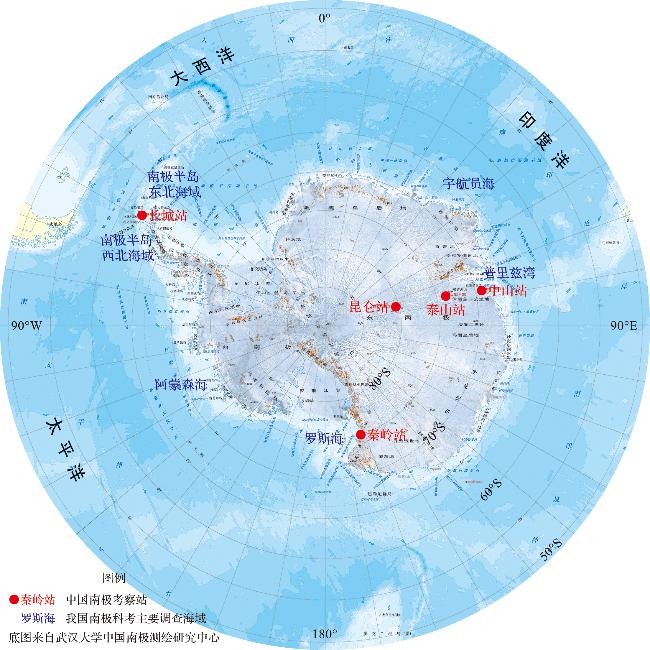
自1984年中国首次开展南极科学考察起,自然资源部第二海洋研究所(前身为国家海洋局第二海洋研究所,简称“海洋二所”)的南大洋生物地球化学研究团队(简称“团队”)便全程参与历次考察,引领了我国在该学科方向的研究工作。四十多年来,团队系统揭示了南极典型海域(图1)海洋生态系统的结构、功能及其与物理过程(如海冰和环流)和化学过程(如生源要素与碳循环)的耦合机制,为理解极地海洋对全球变化的响应提供了理论支撑,从而有力服务了国家南极治理决策。
图1 中国南极考察站和我国南极科考主要调查海域示意图(截至2025年4月)

Fig.1 Schematic map of Chinese Antarctic Research Stations and the main surveyed sea areas of Chinese National Antarctic Research Expeditions (CHINAREs) (as of April 2025)

本文系统回顾团队四十年来在南大洋生物地球化学领域的主要科研贡献,结合不同时期的研究重点演变与国家战略需求,将其发展历程划分为五个阶段:1980年代的“首次南极考察”阶段、1990年代的“开拓东南极考察”阶段、2000年代的“系统深入研究”阶段、2010年代的“南北极环境综合考察与评估”专项阶段以及2020年代的“南极重点海域对气候变化的响应与影响”专项阶段。通过梳理各阶段的标志性成果,展现我国在该领域从无到有、由弱渐强的发展路径,并展望其在应对全球气候变化与服务“海洋强国”战略中的未来方向与关键挑战。

1 深度参与中国首次南极考察

1.1 海洋二所发挥主力军作用

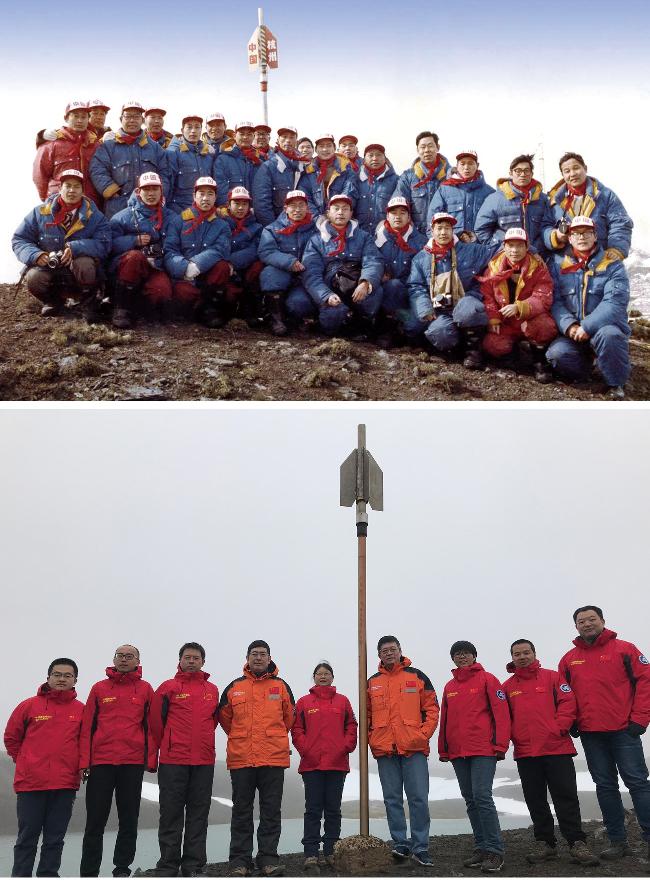
1984年11月至1985年4月,中国首次南大洋考察队对南极半岛西北海域(图1)开展了里程碑式的科学考察。海洋二所作为核心科研力量,共派出26名科研人员参与,由时任副所长金庆明担任队长,科技处长沈楚毅任副队长(图2)。考察获取了涵盖海洋生物地球化学等多学科的宝贵一手数据,为我国南极研究奠定了坚实基础。基于此,沈楚毅于1988年4月主编出版了《南大洋考察报告(南极半岛西北部海区)1984—1985》[15]。随后,中国南极研究学术委员会海洋学组与海洋二所联合举办了我国首届南大洋考察学术讨论会,并出版《南极科学考察论文集(第六集)》[16]。
图2 中国南极长城站西湖畔的回响:从首次远征到第卅五次重逢

[a: 中国首次南极考察(1984—1985年)期间,国家海洋局第二海洋研究所队员合影;b: 中国第35次南极考察(2018—2019年,首席科学家:陈大可院士)期间,自然资源部第二海洋研究所队员合影。两次合影背景中的金属杆为建站纪念地标,系首次考察的海洋二所队员竖立,杆身漆有“中国杭州”和“国家海洋局第二海洋研究所”字样。摄影:蓝木盛。]

Fig.2 Echoes by the West Lake at Chinese Antarctic Great Wall Station: From the first expedition to the 35th reunion

[a: Team members from the Second Institute of Oceanography (SIO), State Oceanic Administration during the 1st Chinese National Antarctic Research Expedition (CHINARE-1, 1984-1985). b: Team members from SIO, Ministry of Natural Resources during CHINARE-35 (2018-2019; Chief Scientist: Academician CHEN Dake). The metal pole visible in both images is a commemorative landmark marking the station’s establishment, erected by SIO members during CHINARE-1. The pole is painted with the words “Hangzhou, China” and the former institutional name “Second Institute of Oceanography, State Oceanic Administration”. Photo by LAN Musheng.]

在首次南极考察之前,海洋二所已开展前瞻性研究。1980年1月—1982年12月,海洋二所科学家通过国际合作,获取并分析了南极多个区域的多学科数据与样品,成果汇编为《南极科学考察论文集(第二集)》[17],为我国首次南极考察积累了重要经验与技术储备。此后,海洋二所持续深耕南极研究,于1993年组织编写了第三次南极考察的综合研究报告[18],进一步深化了对南大洋生态系统的认识。

1.2 开启沉积环境与早期成岩研究

基于首次南极考察样品,团队在多个研究方向取得突破。1989年,率先在《东海海洋》(《海洋学研究》前身)发表南极半岛邻近海域表层沉积物有机质早期成岩特征的研究成果[19],指出有机质分解受降解速率与沉积时间双重控制。进一步对箱式柱样沉积物中硫的早期成岩研究表明,硫酸盐还原与迁移转化具有区域特征,并受环境因子调控[20]。研究还发现,底栖生物的丰度和种类分布与沉积环境密切相关:硫酸盐还原抑制多毛类分布,钙离子浓度影响甲壳类和软体动物分布,低温与氧化还原条件则调控微生物数量[21]。这些成果系统揭示了南大洋早期成岩过程与生物、环境之间的耦合机制。

1.3 多介质氟、碘、硒生物地球化学研究

团队研究了氟、碘、硒等关键生命元素在南大洋多种介质中的生物地球化学行为。在氟方面,发现南极半岛海域海水、沉积物及间隙水中存在“低氟异常”,主要受基岩成分(以角闪石为主)、弱化学风化及氟钙盐沉积影响[22]。对南极大磷虾的研究进一步揭示其外壳存在“富氟异常”,与夏季频繁蜕壳和快速硬化有关,这可能是导致海水中氟含量偏低的关键因素之一[23]。与氟不同,沉积物中碘含量主要受生源物质控制,其再生过程发生于早期成岩阶段,并受pH、碳酸盐平衡体系及氧化还原条件调控[24-25]。在海湾与深海区,碘主要与有机质结合;在陆架与半深海区,则以氧化物结合态吸附于沉积物中。基于此,团队提出了南大洋沉积物中碘迁移与富集的新地球化学模式[25]。硒的生物地球化学行为则表现出与氟和碘不同的特征:尽管沉积物中硒含量区域差异显著,但其化学形态分配比相对一致,部分有机结合态硒可扩散至上覆水体[26]。

2 开拓东南极科学考察

在中国第6次南极科学考察(1989—1990年)期间,我国首次对东南极普里兹湾(图1)开展了综合性海洋调查,海洋二所张海生等科学家参与执行。此后,潘建明、刘小涯等科研人员又相继参加了第7次~第16次南极考察(1990—2000年)。团队逐步构建起对普里兹湾水文结构、生源要素分布、有机碳生产与转化、颗粒物沉降及微量元素行为等方面的综合认知体系。

2.1 深化对氟、碘、硒等微量生命元素生物地球化学行为的认识

在前期研究基础上,团队基于多次考察采集的磷虾样本,系统揭示了其富氟机制:磷虾甲壳中的氟富集并非直接源于生命活动,而是主要通过离子交换吸收海水中的氟,并与钙、磷结合形成氟磷灰石,从而快速增强甲壳结构稳定性[27-28]。进一步研究表明,甲壳中氟占比超过90%,以弱结合态有机氟形式存在,其含量在生长与蜕壳周期中波动显著:蜕壳后新甲壳的氟含量下降,但可通过快速吸收恢复[29]。该机制不仅是生物地球化学循环的重要体现,也反映了南极磷虾在极端环境下的进化适应策略。
团队还分析了海水中碘的赋存形态与化学形式,估算了浮游植物对碘的同化速率、悬浮颗粒物对碘的结合容量及颗粒碘的沉降速率,进而提出了真光层碘循环的生物地球化学模式[30]。在整合多次考察成果后,张海生等人编著出版了《南大洋微量生命元素氟、硒、碘的生物地球化学》[31],系统阐述了这些元素在南极不同区域水体、沉积物及大磷虾中的生物地球化学行为。该著作是我国南极生物地球化学研究的重要阶段性成果,并于1993年获国家海洋科学技术进步三等奖。

2.2 开启水体及沉降颗粒物中有机碳研究

团队开启了南大洋碳循环研究[32]。表层颗粒有机碳(particulate organic carbon,POC)与叶绿素a(Chl a)质量浓度高度相关,指示其来源主要为浮游植物;与营养盐的负相关则表明营养盐消耗直接促进了POC的生成[33]。真光层中活体浮游植物对POC的贡献远高于深层及邻近大洋区,凸显了光照与水层结构对碳输出的调控作用[34]。同时,该区域溶解有机碳(dissolved organic carbon,DOC)浓度高于全球平均水平,上层水体中以难降解组分为主,表现出较强的碳保留能力[35]。POC在沉降过程中可部分转化为DOC,微生物水解作用显著,表明碳在水体中经历了活跃的再循环过程[36]。
随着对极地物质循环时空变异认知的深入,团队认识到多季节、多尺度及长期连续观测的重要性[37]。在第15次南极考察(1998—1999年)期间,团队与美国缅因大学合作,首次在东南极开阔大洋成功布放沉积物捕获器[38],开创了我国对南极沉降物质通量季节性变化研究的先河。结果显示,颗粒物以生物硅(biogenic silica,BSi)为核心组分,印证了该海域以硅藻为主导的生态系统特征;沉降通量呈现显著季节性变化,夏季远高于秋冬季,与海冰的季节性消长密切相关[32]。元素摩尔比值进一步表明,BSi与POC的生物地球化学循环过程存在解耦现象,生物活动对POC的再矿化作用显著,此特征与罗斯海有所不同[39-40]。这些结果证实,南极深海颗粒物通量受海冰-初级生产力季节性耦合的调控,硅藻驱动的生物泵通过解耦的硅-碳循环强化了碳汇功能,为评估全球变化背景下南极碳循环的响应机制提供了关键科学依据。

3 系统性深入研究

进入21世纪以来,依托中国第17次~第27次南极考察(2000—2011年),团队聚焦普里兹湾及邻近海域,系统开展了碳的生物地球化学循环研究。通过多尺度、多介质、多手段的综合观测,在有机碳分布与转化、沉降颗粒物季节特征及沉积环境等方面取得一系列重要认识。相关成果由张海生、潘建明、扈传昱等系统总结为“南大洋普里兹湾碳的生物地球化学研究”,并于2006年获海洋创新成果二等奖。

3.1 水体颗粒有机碳特征及调控机制

多航次数据表明,夏季普里兹湾上层水体中POC和BSi呈现“湾内高、湾外低”,且随水深增加显著降低的分布格局[41-44]。该区POC浓度显著高于热带与亚热带海域,表明其初级生产未受常量营养盐限制[42]。POC与BSi分布存在年际波动,与浮游植物优势种年际更替有关[43-44]。进一步研究发现,开阔大洋存在Chl a深层最大值,可能与铁等微量元素缺乏有关;而湾内高浓度铵盐可能抑制浮游植物对硝酸盐的吸收,进而削弱对CO2的净吸收[45]。
团队同期开展了普里兹湾水体溶解态痕量元素的研究。表层海水痕量元素含量与南印度洋、南极气溶胶及近岸湖泊相近,其中铜、镉受悬浮颗粒物、初级生产力和盐度调控,锌则可能受人类活动影响[46]。另外,镉的垂直分布与磷酸盐相关,反映其受有机颗粒降解控制[47]。

3.2 关键过程量化与长期变化分析

现场浮游植物培养实验估算了碎屑耗氧与营养盐再生速率,为南大洋有机质循环提供了定量依据[48]。间隙水中硅酸盐与铵盐含量高、垂向梯度大,表明早期成岩以BSi溶解和厌氧有机质降解为主,向上覆水释放是营养盐再生的重要途径,强化了沉积物-水界面生物地球化学耦合[49-50]。数学模型进一步量化了水体有机碳与无机碳的分解比例,有助于降低碳垂向输运中再矿化量的不确定性[41]。
基于1990—2011年现场与遥感数据,发现Chl a质量浓度呈现“湾内高、湾外低”格局,并与多变量厄尔尼诺指数相关:厄尔尼诺年Chl a较高、硅藻比例上升;而拉尼娜年则Chl a偏低,金藻与蓝藻比例增加,说明高纬度浮游植物动态响应厄尔尼诺-南方涛动(El Niño-Southern Oscillation,ENSO)事件,反映极地生态对气候强迫的敏感性[51-52]。

3.3 生源要素沉降通量的季节特征

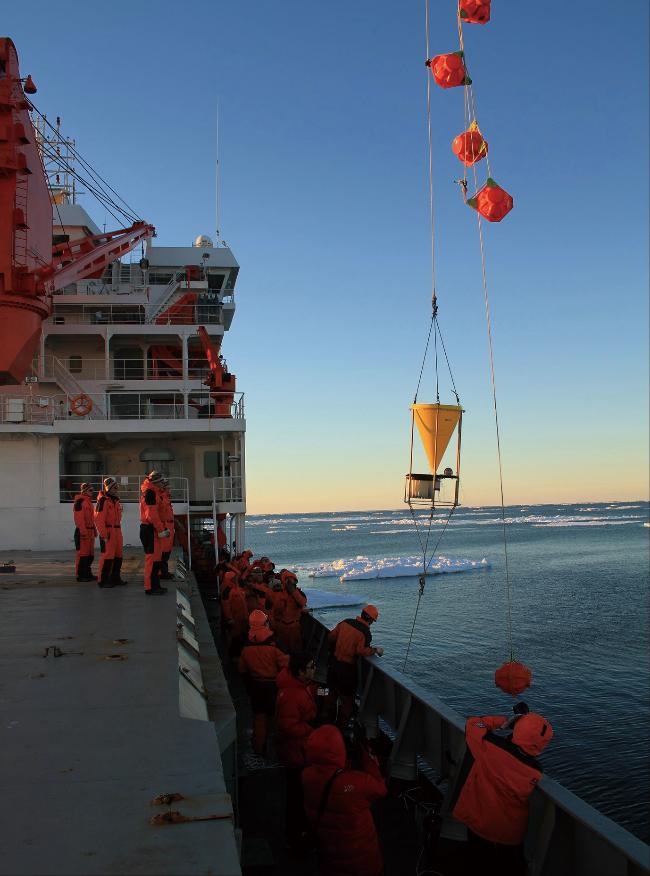
自第26次南极考察(2009—2010年)起,团队在普里兹湾布放沉积物捕获器,实现了生物地球化学过程的长时间序列观测(图3)。初步结果显示,颗粒物通量具有显著季节变化,夏季最高,与海冰动态密切相关,硅质生物泵主导POC输出[53]。海洋源元素(铜、锌、镉、钡)通量季节变化与生源输出一致,受控于海冰覆盖与生产力;而陆源矿物元素(铝、铁、锰、铅、钴)通量则主要受海冰消融与冻结调控[54-55]。
图3 我国成功回收首套在南极边缘海布放并运行一年的时间序列沉积物捕获器

[该套配备时间序列沉积物捕获器的锚系潜标系统,系中国第27次南极考察(2010—2011年)期间由海洋二所科研人员在普里兹湾布放,并于次年通过中国第28次南极考察顺利收回。此举首次实现了基于无人值守平台对南极高碳汇边缘海沉降物质通量季节性变化的连续观测,为研究极地生态系统与碳汇格局演变提供了重要数据支撑。摄影:韩喜彬。]

Fig.3 China has successfully retrieved its first time-series sediment trap that had been deployed and operated for one year in the Antarctic marginal sea

[The moored submersible buoy system equipped with a time-series sediment trap was deployed in Prydz Bay by researchers from SIO during CHINARE-27 (2010-2011) and successfully recovered the following year during CHINARE-28. This achievement marks the first continuous unmanned observation of seasonal variations in settling particulate flux in the high-carbon-sink Antarctic marginal sea, providing key data for research on polar ecosystem dynamics and carbon sink patterns. Photo by HAN Xibin.]

3.4 沉积记录中的生物地球化学信息

团队研究拓展至沉积碳循环。普里兹湾沉积速率空间异质性显著:生物量大、水体稳定的湾中心区较高,冰架前缘较低,主要受生物生产、物理环境与底栖活动影响[56]。有机质主要为海源,与泥质含量呈正相关,反映水动力影响;高埋藏率(39%~91%)表明该湾是重要碳汇区[57]。沉积物中BSi含量与上覆水体营养盐、Chl a及初级生产力密切相关,可作为上层生产力的代用指标;其保存效率高于总有机碳(total organic carbon,TOC),部分解释了南大洋(贡献全球约8%的海洋初级生产力)为何聚集全球35%~70%的BSi[58-60]。自生磷、有机磷分布与TOC、BSi类似,碎屑磷的分布则与铝和砂含量一致[61]。
生物标志物进一步揭示了沉积生物地球化学过程。TOC和糖类的分布与BSi协同变化,糖类占TOC比例达26%,高于全球平均水平,反映“新鲜”有机质的主导贡献与高效保存[62]。类脂物分布指示TOC与上层生产力密切相关;甾烷组成揭示磷虾与硅藻的食物链关系[63]。基于生物标志物的历史重建,首次揭示浮游植物丰度及群落结构与气候事件的关联:厄尔尼诺年硅藻比例上升、甲藻比例下降[64-66]。不饱和脂肪酸比例可定性指示表层水温;基于甘油双烷基甘油四醚(glycerol dialkyl glycerol tetraether,GDGT)的TEX86指标与夏季海表温度具有良好相关性,从而具备古海温重建潜力[63,67]。上述研究为理解南大洋生态系统对气候变化的响应提供了关键依据。
主、微量元素可解析物质来源。基于多次考察获得的表层沉积物分析显示,湾中心及东南区沉积作用受控于上层生物生产,而浅滩与冰架前缘则以冰筏碎屑输入为主[68-69]。初级生产力的区域差异通过锗、钡[70-71]、锌、镉[72]及蛋白石中的锌、锗[73-74]等生源痕量元素记录于沉积物中,是探究南极生物泵效率与结构历史变化的有效手段。

4 南极环境综合考察与评估

新时代以来,张海生与潘建明推动了“南北极环境综合考察与评估”专项(2011—2015年)的立项,标志着我国南极科考进入高速发展新阶段。依托中国第28次~第35次南极考察(2011—2019年),研究区域从长期考察的普里兹湾逐步扩展至南极半岛东北海域、罗斯海及阿蒙森海等不同生态环境特征海域(图1)。第35次南极考察(2018—2019年)由陈大可院士担任首席科学家(图2),是我国首次由院士担任该职。
同期,团队取得多项成果与荣誉。2017年,团队所在集体获“中国极地考察先进集体”称号,扈传昱获“中国极地考察先进个人”称号(享受省部级劳模待遇)。潘建明主编了专项报告《南极周边海域海洋化学与碳通量考察》[75],赵军参编《南极周边海域海洋地质考察》[76]。2018年,张海生主编《循环、作用和影响:南大洋观测与研究》[77],系统总结了我国南大洋研究30年成果;同年牵头编写《中国极地科学创新研究发展报告》[78],提出跨学科关键科学问题,为我国南大洋生物地球化学研究指明方向。

4.1 长期考察海域:普里兹湾

基于长期观测,团队系统揭示了普里兹湾水体、沉降颗粒物和沉积物中碳循环与生物地球化学过程的特征。多年数据表明,浮游植物生产力及种群结构(Chl a、BSi)年际变化显著,受ENSO调控的海冰消融影响[79]。夏季营养盐消耗呈现“湾内高、湾外低”的特征,与初级生产力分布一致;湾内硅消耗相对较低可能与铁供应充足有关[80],这深化了对生源要素循环机制的认识。表观耗氧量(apparent oxygen utilization,AOU)与N2O浓度正相关,反映深水硝化作用促进N2O积累,为极地近岸N2O动力学提供了新见解[81]。
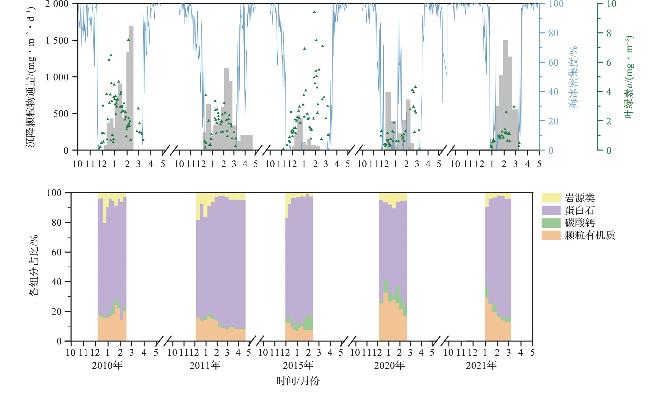
沉降颗粒物通量及组成分析显示年际差异显著:缺乏“压舱物”导致有机质沉降缓慢,促进异养微生物降解[82](图4)。浮游动物及其粪粒对碳沉降贡献起关键作用,冬季翼足类残骸、夏季晶磷虾粪粒分别主导POC通量[83]。沉积物捕获器与表层沉积物研究表明,硅质微体生物通量受海冰和浮游植物群落调控,放射虫组合可指示海冰、生产力、摄食压力及变性绕极深层水(modified circumpolar deep water,mCDW)入侵等环境变化[84-85],为南大洋现代与古海洋研究提供了新指标。
图4 南极普里兹湾颗粒物沉降通量存在显著的年际波动

[2014—2015年期间的颗粒有机碳(POC)沉降通量仅为2009—2010年同期的12.5%。这种差异主要归因于缺乏足够的“压舱物”效应,导致上层水体中的有机质无法快速沉降,从而使其更充分地被异养微生物降解,降低了POC的沉降效率。此外,海冰融化通过影响浮游植物的旺发、群落演替以及浮游动物的摄食行为,也对颗粒物沉降通量产生调控作用[53,82,91]。]

Fig.4 Significant interannual fluctuations in the particulate matter flux in Prydz Bay, Antarctica

[The particulate organic carbon (POC) flux during 2014-2015 was only 12.5% of that recorded in 2009-2010. This difference was primarily attributed to the insufficient “ballast effect”, which hindered the rapid sinking of organic matter from the upper water layer. As a result, the organic matter was more thoroughly degraded by heterotrophic microorganisms, reducing the deposition efficiency of POC. Additionally, sea ice melting also modulated the particulate flux by influencing phytoplankton blooms, community succession, and zooplankton grazing behavior[53,82,91].]

表层沉积物生物标志物分析显示,脂肪酸最丰富,其次为甾醇、脂肪醇与烷烃,除浮游植物外,细菌贡献显著。季节性海冰控制藻类旺发,驱动沉积有机质空间分异[86]。团队研究阐明了GDGT温度指标的生物学机制,建立了其与次表层水温的定量关系,提出OH-GDGT可作为南极边缘海次表层温度指标[87]。高活性铁(highly reactive iron,FeHR)含量极低,与TOC无显著相关性,为理解全球海洋FeHR与TOC的关系提供了新视角[88-89]。岩心记录表明,末次间冰期以来生源微量元素富集与冰期-间冰期旋回同步[90]。

4.2 低纬亚南极海域:南极半岛

南极半岛海域纬度较低、地形复杂、水团交换频繁,营养盐与生产力时空变异性高。夏季表层POC浓度及非生命组分占比区域差异显著,与Chl a分布一致而与营养盐相反,主要受温度、水团混合与海冰融化调控[92]。光合色素分析表明硅藻为主要功能群,在稳定水体与融冰区占优,而南极棕囊藻偏好低光高营养环境[93],揭示了环境驱动对浮游植物群落结构的影响。浮游植物与微型浮游动物共存区观测到超高浓度二甲基硫(dimethyl sulfide,DMS),表明浮游动物摄食浮游植物促进DMS释放,进而可能影响云层的形成[94]。溶解氧(dissolved oxygen,DO)、总碱度与溶解无机碳(dissolved inorganic carbon,DIC)计算显示,人为碳吸收与酸化模式存在区域差异,对流等水文过程为主控因素[95]。基于浮标数据评估夏季POC输出通量,发现乔治亚海盆铁供给维持了4个月时长的浮游植物旺发,混合层加深促进POC输出,挑战了“高生产力、低输出效率”的传统认识,凸显了高分辨率多参数观测的重要性[96]。表层沉积有机质来源区域差异显著:西部以南极半岛与南设得兰群岛陆源输入为主,东部以海源浮游生物、藻类与细菌为主,氧化还原环境受水团混合与火山活动影响[97]。

4.3 底层水生产海域:罗斯海

作为南极底层水形成地与重要的碳汇区,罗斯海的生态与地球化学过程备受关注。团队研究涵盖现代水体生态、沉积历史与地球化学机制,揭示了该海域铁对生物泵的关键调控作用。浮游植物组成、Chl a、POC、营养盐与痕量金属分析表明,铁源于深层水垂直混合,是生产力的核心限制因子,并调控浮游植物元素吸收比,影响生物泵效率[98]。沉积物的FeHR空间异质性受岩性、风化与海冰融水等多因子控制;FeHR与TOC耦合关系的区域差异显著,影响TOC埋藏,凸显了铁循环对碳封存的作用[99]。GDGT分析显示,TE ${X}_{86}^{L}$指标在罗斯海适用[100]。正构烷烃揭示,西部有机质以浮游植物与细菌为主,东部混入风尘与中纬度植物蜡质信号,反映海冰消融与水团变化的影响[101]。柱样研究表明,自末次盛冰期以来,随着冰架退缩,TOC来源由陆源主导转为现代海源主导,由此建立了冰架变化与碳埋藏的气候关联[101]。

4.4 变暖显著海域:阿蒙森海

作为南极生产力最高、对全球变暖响应最敏感的大陆边缘海之一,阿蒙森海正经历冰川退缩、冰架崩塌与海冰快速变化,已成为南大洋海冰消退最快的区域。我国第34次南极考察(2017—2018年)首次在此成功布放锚系潜标(含沉积物捕获器),奠定了长期生态环境观测基础。
团队研究发现该海域的浮游植物群落对海冰融水与绕极深层水入侵响应敏感,结构与生物量空间变异性高:在海冰消融时间短、混合层浅的区域,生物量与硅藻比例随水深增加迅速下降;在海冰消融时间长、绕极深层水(circumpolar deep water,CDW)上升流有限的区域,以微型浮游植物为主,生物量低且垂直分布稳定[102]。硅藻对营养盐分布影响显著,其吸收率与优势种群对应,铁供应调节非限制性营养元素分布模式[98]。环境因子(温度、硝酸盐、DO、铵等)可解释浮游动物丰度/生物量方差的40%以上,表明物理过程与化学要素共同塑造了浮游动物群落结构[103]。

4.5 企鹅栖息地环境研究

南极半岛长城站附近是企鹅的重要栖息地,受全球变暖影响显著。团队开展了涵盖生态、沉积与生物地球化学的多项研究,发现ENSO事件通过食物链影响企鹅种群,帽带企鹅对人为干扰更敏感;粪土沉积物中的正构烷烃与脂肪酸组成反映了微生物活动与植被变化[104-108]。污染物呈现生物富集效应,受营养级与食性调控:贼鸥因捕食企鹅卵及跨半球迁徙,卵中持久性污染物积累最高;企鹅摄食磷虾导致脂肪组织中多氯联苯浓度较高,卵中污染物富集序列为多氯联苯>滴滴涕>六氯苯>六六六[109-110]。

5 南极重点海域对气候变化的响应与影响

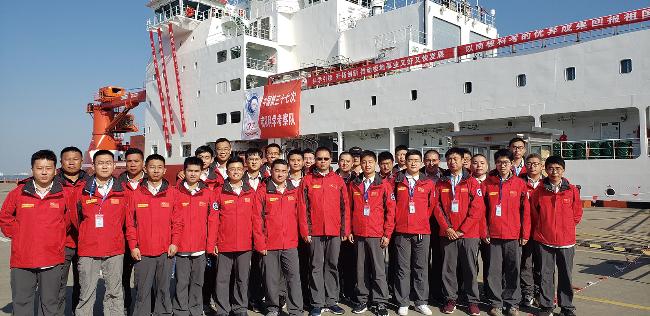
近年来,张海生与潘建明推动设立了“南极重点海域对气候变化的响应与影响”专项(2020—2024年)。潘建明担任第36次南极考察(2019—2020年)首席科学家,实现了我国首次进入西南极阿蒙森海冰间湖开展系统调查研究。该航次也开启了在东南极宇航员海的科学考察,这两个海域正是上述专项的重点研究区域(图1)。随后,时年38岁的赵军担任第37次南极考察(2020—2021年)首席科学家,成为我国极地考察最年轻的首席科学家[111](图5)。2026年,团队所在集体再次荣获“中国极地考察先进集体”称号,赵军获评“中国极地考察先进个人”称号。
图5 中国第37次南极考察(2020—2021年)出发前,全体海洋科学考察队员合影

[本航次由自然资源部任命海洋二所赵军副研究员(前排右六)担任首席科学家。考察由“雪龙2号”单船执行,历时179天,成为我国迄今历时最长的单船南极科学考察任务。此次考察旨在系统掌握南极重点海域的基础生态系统特征与水体和底质环境状况,评估全球气候变化对南极关键海域的海洋环境、特殊生境、关键物种及主要生态过程的影响,为相关研究提供了重要的基础数据和科学依据[111]。]

Fig.5 Group photo of all marine scientific team members before the departure of CHINARE-37 (2020-2021)

[This expedition, with Associate Researcher ZHAO Jun (front row, 6th from right) from SIO appointed as the chief scientist by the Ministry of Natural Resources, was carried out by the icebreaker “Xue Long 2” over 179 days, making it China’s longest single-vessel Antarctic scientific mission to date. The expedition aimed to systematically characterize the basic ecosystem features and the hydrographic and substrate conditions in key Antarctic sea areas, and to assess the impacts of global climate change on the marine environment, unique habitats, key species, and major ecological processes in these regions. The work has provided essential baseline data and scientific support for related research[111].]

团队聚焦南大洋生态系统与生物地球化学循环的前沿问题,系统研究浮游植物季节演替及其对碳封存的影响,支撑专项核心目标,成果发表于《Acta Oceanologica Sinica》纪念我国极地考察40周年专刊。赵军联合国际学者在《Frontiers in Marine Science》组织主题专辑《Role of the Southern Ocean in atmospheric pCO2 change: observations, simulations and paleorecords》(ISBN 978-2-8325-5862-1)[112],收录中、韩、美、澳等国共12篇论文,推动了南极科学国际交流,展现了我国在该领域的学术影响力。潘建明在《极地研究》撰文,系统总结了专项成果,提出了未来南大洋生态环境研究建议[113]。

5.1 长期考察海域:普里兹湾

团队采用高分辨率FT-ICR MS技术,揭示了普里兹湾夏季冰间湖DOC的来源与垂向变化:生物降解主导POC矿化,主要发生于200 m以浅水体,生成DOC与DIC,封存于深层并进入区域环流,而非释放至大气[114]。两年的沉降颗粒物观测显示,海冰晚融显著提升了夏季颗粒物通量与POC输出,提高BSi/POC比,促使硅藻占优、磷虾减少[91]。该研究首次量化了海冰融化时间对碳输出的调控作用,深化了对南极边缘海气候响应机制的认识(图4)。多年沉积物样品分析表明,普里兹湾生物碳泵效率为5.7%,远高于全球均值(约0.8%),TOC埋藏效率达79%±20%,凸显了南极边缘海的强碳封存能力[115]。

5.2 宽陆架生境:阿蒙森海

团队在阿蒙森海开展系统观测,揭示了该海域生态结构、生物地球化学过程及其对碳汇的影响。DO分布显示,表层AOU与Chl a呈显著负相关,反映了藻华的释氧效应,在冰间湖尤为显著;200 m层AOU最高(<160.0 μmol·L-1),指示CDW入侵过程中水体性质显著变化[116-117]。病毒丰度与自养微型真核生物及Chl a正相关,冰缘藻华与CDW上涌共同促进了生物量积累与碳的垂向输运[118]。
物理环境变化(如冰川融水路径、海冰形成)调控营养盐与POC分布,影响生物地球化学过程[119]。浮游植物群落结构与粒径显著影响POC与DOC积累,是碳泵效率差异的关键[120]。冰间湖高生产力区的透明胞外聚合物(transparent exopolymer particles,TEP)浓度高,主要源自硅藻,修正了南极TEP主要由甲藻产生的传统观点[121-122]。溶解有机质(dissolved organic matter,DOM)与藻华同步变化,微生物主导其降解及腐殖质生成,水团、光照与生物过程共同调控其组成[123]。上述研究系统揭示了阿蒙森海生态系统各组分对物理变化的响应机制,为评估极地碳汇及完善碳循环模型提供了依据。

5.3 窄陆架生境:宇航员海

宇航员海作为东南极重要的边缘海,相关的生物地球化学研究较少。第36次南极考察首次在该海域开展生态锚系潜标时间序列观测。团队系统整合了营养盐分布、碳同位素示踪、浮游植物演替与氮循环等关键过程。DO分布显示,高初级生产区表层DO饱和、AOU低,无显著季节差异;100~300 m层AOU最高(>160.0 μmol·L-1),表明CDW可上涌至100 m且性质稳定;底层AOU低于125.0 μmol·L-1,指示南极底层水的存在,AOU可作为水团特征指标[116-117]。
浮游植物分析表明,海冰融化和威德尔涡旋上升流为南极棕囊藻提供了关键铁源,群落呈“小型化”趋势,与海冰扩展相关[124]。营养盐时空变化显示,12月至2月间优势种群由南极棕囊藻转为硅藻,硅酸盐消耗剧增,凸显了营养盐对群落与生物泵的调控作用[125-126]。CDW上涌亦促进异养原核生物增殖[127]。强烈微生物活动是去除蛋白质类DOM并生成腐殖质的关键,可导致DOC与浮游植物垂向分布解耦[128]。研究首次量化了冰藻对底层POC的贡献(6%~19%),揭示其在深海碳输运中的作用[129]。首次证实了硝酸盐-亚硝酸盐同位素交换受铁浓度调控,影响硝酸盐同化效应[130]。上述系列成果为理解宇航员海生态与碳氮循环对气候变化的响应提供了科学支撑。

5.4 环南极视野:开阔大洋

南大洋吸收了全球海洋约40%的CO2,其中生物泵贡献约为10%。综合现场观测、遥感与模型的研究显示,碳输出效率在低于6 °C时对温度的响应较弱;“高生产力、低输出效率”现象多见于亚南极区与极锋区等高纬冷水区,揭示温度对海洋碳循环的调控作用,提示气候变暖可能抑制碳输出效率,削弱碳汇功能;非沉降有机质、生态系统结构及输出效率区域特异性的参数化是量化南大洋输出过程的关键因素[131]。冰藻对磷虾越冬期间饵料贡献的研究表明,高纬度海域磷虾摄食与体长有关,早期成体更依赖冰藻,摄食冰藻可提升其营养级;在初级生产不足的开阔水域,磷虾转向动物性饵料,暗示海冰减少可能威胁磷虾种群、渔业可持续性与生态系统稳定[132]。

6 总结与展望

四十多年来,团队围绕南大洋碳循环、生态响应机制、观测平台与方法学创新等领域,逐步构建了多层次的研究体系,为理解极区环境对全球气候变化的响应提供了扎实的数据与理论基础。近年来,团队在阿蒙森海、罗斯海、普里兹湾、宇航员海及南大洋开阔海域等典型区域,形成了“观测-机制解析-技术创新”为一体的系统性研究格局。从生态系统结构与生物地球化学过程解析,到物理环境变异、海冰动态、微量元素调控及分子机制探索,研究逐步揭示了极区碳循环的多尺度响应与复杂反馈机制。团队的研究成果为我国参与南极国际治理提供了坚实的科学支撑。在支撑国际治理政策制定方面,团队围绕南大洋碳汇功能、生物资源变动、污染物迁移等关键问题开展的系统研究,为《南极条约》体系下的环境保护与资源管理、CCAMLR的渔业科学建议以及全球气候谈判中的南极议题提供了重要的本地化数据与科学依据。在服务全球气候治理方面,团队对南大洋碳循环机制、生物泵效率及其气候响应的持续研究,为国家“双碳”战略下的国际气候谈判与全球碳收支评估提供了重要的极地科学视角。此外,团队通过组织国际专题研究、发表高水平论文、开展联合观测等方式,积极促进了南极科学领域的国际交流与合作,提升了我国在南极事务中的科学话语权与影响力。
站在前人积累的基础上,未来南大洋生物地球化学研究应聚焦以下重点方向:开展南大洋碳汇能力的长期监测与评估,服务国家“双碳”目标需求;深入研究南大洋生源要素结构的长期演变规律及其对高营养级生物的影响;持续推进南极关键海域环境与生态系统的长期观测,积极参与南极海洋保护区保护成效的科学评估;探索渔业碳汇的区域与季节特征及其驱动机制,拓展南极生物地球化学研究新维度;积极对接并融入国内外重大极地研究计划(如第五次国际极地年等)。
未来,团队将继续面向国家极地战略与全球气候治理需求,持续推动我国南极海洋科学研究的高质量发展,把海洋二所建设成为我国极地考察的“重要窗口”单位,为“认识南极、保护南极、利用南极”提供更加坚实的科技支撑。
致谢 巍巍南极,见证着中国海洋科考的壮丽征程。
谨向参加中国首次南极考察的28位海洋二所前辈致敬!1984年,他们乘“向阳红10”号破冰前行,以无畏的精神开辟了中国极地科考新纪元,以科学家的勇气与智慧奠定了海洋二所的南极科研基石。
亦向海洋二所南大洋生物地球化学研究团队致敬!四十载,他们坚守科研一线,以严谨态度和坚韧精神,在本领域不断突破,揭示南大洋生态系统的奥秘,为我国极地事业作出重要贡献。
从开拓到坚守,这种薪火相传正是新时代南极精神最生动的诠释!
[1]
BIANCHI T S. The evolution of biogeochemistry: Revisited[J]. Biogeochemistry, 2021, 154(2): 141-181.

DOI

[2]
BALIÑO B M, FASHAM M J R, BOWLES M C. Ocean biogeochemistry and global change: JGOFS research highlights 1988—2000[M]. Stockholm, Sweden: IGBP, 2001: 36.

[3]
ROGERS A D, FRINAULT B A V, BARNES D K A, et al. Antarctic futures: An assessment of climate-driven changes in ecosystem structure, function, and service provisioning in the Southern Ocean[J]. Annual Review of Marine Science, 2020, 12: 87-120.

DOI PMID

[4]
GRUBER N, LANDSCHÜTZER P, LOVENDUSKI N S. The variable Southern Ocean carbon sink[J]. Annual Review of Marine Science, 2019, 11: 159-186.

DOI PMID

[5]
BOYD P W, ARRIGO K R, ARDYNA M, et al. The role of biota in the Southern Ocean carbon cycle[J]. Nature Reviews Earth & Environment, 2024, 5: 390-408.

[6]
KAWAGUCHI S, ATKINSON A, BAHLBURG D, et al. Climate change impacts on Antarctic krill behaviour and population dynamics[J]. Nature Reviews Earth & Environ-ment, 2024, 5(1): 43-58.

[7]
TRÉGUER P, BOWLER C, MORICEAU B, et al. Influence of diatom diversity on the ocean biological carbon pump[J]. Nature Geoscience, 2018, 11(1): 27-37.

DOI

[8]
WILLIAMS J R, GIERING S L C, BAKER C A, et al. Inefficient transfer of diatoms through the subpolar Southern Ocean twilight zone[J]. Nature Geoscience, 2025, 18: 72-77.

DOI PMID

[9]
RYAN-KEOGH T J, THOMALLA S J, MONTEIRO P M S, et al. Multidecadal trend of increasing iron stress in Southern Ocean phytoplankton[J]. Science, 2023, 379(6634): 834-840.

DOI

[10]
TRINH R, DUCKLOW H W, STEINBERG D K, et al. Krill body size drives particulate organic carbon export in West Antarctica[J]. Nature, 2023, 618(7965): 526-530.

DOI

[11]
CAVAN E L, MACKAY N, HILL S L, et al. Antarctic krill sequester similar amounts of carbon to key coastal blue carbon habitats[J]. Nature Communications, 2024, 15: 7842.

DOI PMID

[12]
LAUFKÖTTER C, GRUBER N. Will marine productivity wane?[J]. Science, 2018, 359(6380): 1103-1104.

DOI PMID

[13]
GRORUD-COLVERT K, SULLIVAN-STACK J, ROBERTS C, et al. The MPA Guide: A framework to achieve global goals for the ocean[J]. Science, 2021, 373(6560): eabf0861.

[14]
KENNICUTT M C, BROMWICH D, LIGGETT D, et al. Sustained Antarctic research: A 21st century imperative[J]. One Earth, 2019, 1(1): 95-113.

DOI

[15]
国家南极考察委员会, 国家海洋局. 南大洋考察报告(南极半岛西北部海区)1984—1985[M]. 北京: 海洋出版社, 1988.

The National Antarctic Expedition Committee, State Oceanic Administration. Observational report on the Southern Ocean research (the sea area northwest of the Antarctic Peninsula)1984-1985[M]. Beijing: China Ocean Press, 1988.

[16]
国家南极考察委员会. 中国第一届南大洋考察学术讨论会论文专集:南极科学考察论文集:第六集[M]. 上海: 上海科学技术出版社, 1989.

The National Antarctic Expedition Committee. Proceedings of the First Chinese Symposium on Southern Ocean research: Collection of papers from the Antarctic Scientific Expedition: Volume Ⅵ[M]. Shanghai: Shanghai Science and Technology Press, 1989.

[17]
国家南极考察委员会. 南极科学考察论文集:第二集[M]. 北京: 海洋出版社, 1984.

The National Antarctic Expedition Committee. Collection of papers from the Antarctic Scientific Expedition: Volume II[M]. Beijing: China Ocean Press, 1984.

[18]
国家南极考察委员会. 中国第三次南大洋考察暨环球重力调查报告[M]. 北京: 海洋出版社, 1993.

The National Antarctic Expedition Committee. Observational report on China’s third Southern Ocean research and global gravity survey[M]. Beijing: China Ocean Press, 1993.

[19]
程先豪, 张健. 马克斯韦尔湾有机质的某些早期成岩特征[J]. 东海海洋, 1989, 7(1):71-78.

CHENG X H, ZHANG J. Maxwell Bay, Characteristics of early diagenesis of organic matters, Maxwell Bay, Antarctic Ocean[J]. Donghai Marine Science, 1989, 7(1): 71-78.

[20]
王成厚, 程先豪. 马克斯威尔湾和阿得米拉达湾底部硫的早期化学成岩[J]. 海洋与湖沼, 1990, 21(5):465-473.

WANG C H, CHENG X H. The early chemical diagenesis of sulfur in Maxwell and Adimiralty bays of Antarctic[J]. Oceanologia et Limnologia Sinica, 1990, 21(5): 465-473.

[21]
程先豪, 王永泓, 夏卫平, 等. 南大洋底栖生态环境研究I: Maxwell湾和Admiralty湾[J]. 南极研究, 1992, 4(3):38-45.

CHENG X H, WANG Y H, XIA W P, et al. Research on the benthic ecology environment, Antarctic Ocean I: Maxwell Bay and Admiralty Bay[J]. Antarctic Research, 1992, 4(3): 38-45.

[22]
程先豪, 张海生, 夏卫平. 西南极海沉积体系中的氟异常[J]. 南极研究, 1990, 2(4):36-44.

CHENG X H, ZHANG H S, XIA W P. Anomaly of fluorine in a sedimentary system, western Antarctic Ocean[J]. Antarctic Research, 1990, 2(4): 36-44.

[23]
张海生, 夏卫平, 程先豪, 等. 南大洋氟的生物地球化学研究I. 南极磷虾富氟异常的研究[J]. 南极研究, 1991, 3(4):24-30.

ZHANG H S, XIA W P, CHENG X H, et al. A study of fluoride anomaly in Antarctic krill[J]. Antarctic Research, 1991, 3(4): 24-30.

[24]
程先豪, 夏卫平, 张海生, 等. 西南极海碘的早期成岩作用和生物地球化学[J]. 海洋与湖沼, 1992, 23(2):115-123.

CHENG X H, XIA W P, ZHANG H S, et al. Early diagenesis and biogeochemistry of iodine in west Antarctic Ocean[J]. Oceanologia et Limnologia Sinica, 1992, 23(2): 115-123.

[25]
程先豪, 夏卫平, 张海生, 等. 西南极海沉积物碘的迁移与富集[J]. 南极研究, 1992, 4(2):1-9.

CHENG X H, XIA W P, ZHANG H S, et al. Remobilization and accumulation of iodine in sediments, western Antarctic Ocean[J]. Antarctic Research, 1992, 4(2): 1-9.

[26]
潘建明, 张海生, 程先豪, 等. 西南极海沉积硒的地球化学状态[J]. 海洋与湖沼, 1998, 29(4):424-430.

PAN J M, ZHANG H S, CHENG X H, et al. Geochemical state of sedimentary selenium in western Antarctic Ocean[J]. Oceanologia et Limnologia Sinica, 1998, 29(4): 424-430.

[27]
张海生, 潘建明, 程先豪, 等. 南大洋氟的生物地球化学研究 II.氟在南极磷虾甲壳中的动态变异及其富集原因[J]. 南极研究, 1992, 4(1): 17-22.

ZHANG H S, PAN J M, CHENG X H, et al. Biogeochemistry research of fluoride in Antarctic Ocean II. The variation characteristics and accumulation cause of fluoride in the cuticle of Antarctic krill[J]. Antarctic Research, 1992, 4(1): 17-22.

[28]
张海生, 潘建明, 刘小涯. 南极磷虾富氟异常的原因及机理[J]. 海洋学报, 1994, 16(4):120-125.

ZHANG H S, PAN J M, LIU X Y. The causes and mechanisms of fluorine enrichment in Antarctic krill[J]. Acta Oceanologica Sinica, 1994, 16(4): 120-125.

[29]
潘建明, 张海生, 刘小涯. 南大洋磷虾富氟机制 Ⅰ.氟的化学赋存形态研究[J]. 海洋学报, 2000, 22(2):58-64.

PAN J M, ZHANG H S, LIU X Y. The fluorine enrichment mechanics of Antarctic krill I. The fluorine chemical formation[J]. Acta Oceanologica Sinica, 2000, 22(2): 58-64.

[30]
程先豪, 潘建明, 张海生, 等. 南大洋碘分布的生物制约性[J]. 海洋与湖沼, 1994, 25(1):28-47.

CHENG X H, PAN J M, ZHANG H S, et al. Biolimitation of iodine distribution in Antarctic Ocean[J]. Oceanologia et Limnologia Sinica, 1994, 25(1): 28-47.

[31]
张海生, 程先豪, 夏卫平, 等. 南大洋微量生命元素氟、硒、碘的生物地球化学[M]. 北京: 海洋出版社, 1992.

ZHANG H S, CHENG X H, XIA W P, et al. The biogeochemistry of bio-essential trace elements (fluorine, selenium, and iodine) in the Southern Ocean[M]. Beijing: China Ocean Press, 1992.

[32]
张海生, 扈传昱, 潘建明, 等. 南极普里兹湾北部深海沉降颗粒物通量的季节性变化[J]. 地球化学, 2003, 32(4):358-362.

ZHANG H S, HU C Y, PAN J M, et al. Seasonal variability in deep ocean particle fluxes in the north open sea of Prydz Bay[J]. Geochimica, 2003, 32(4): 358-362.

DOI

[33]
扈传昱, 张海生, 潘建明, 等. 夏季南极普里兹湾碳的生物地球化学循环II: POC的分布特征[J]. 极地研究, 2001, 13(3):195-204.

HU C Y, ZHANG H S, PAN J M, et al. The biogeochemistry of carbon cycle in summer of the Prydz Bay, Antarctica II: Characteristics of POC distribution[J]. Chinese Journal of Polar Research, 2001, 13(3): 195-204.

[34]
刘子琳, 潘建明, 陈忠元, 等. 南大洋浮游植物现存量对颗粒有机碳的贡献[J]. 海洋科学, 2004, 28(5):44-49.

LIU Z L, PAN J M, CHEN Z Y, et al. Contribution of phytoplankton standing stock to particulate organic carbon in the Southern Ocean[J]. Marine Sciences, 2004, 28(5): 44-49.

[35]
扈传昱, 潘建明, 刘小涯, 等. 夏季南极普里兹湾碳的生物地球化学循环Ⅰ: DOC的含量与分布[J]. 极地研究, 2003, 15(1):28-34.

HU C Y, PAN J M, LIU X Y, et al. The biogeochemistry of carbon cycle in summer of the Prydz Bay, Antarctic I: Characteristics of DOC distribution[J]. Chinese Journal of Polar Research, 2003, 15(1): 28-34.

[36]
扈传昱, 潘建明, 张海生, 等. 夏季南极普里兹湾碳的生物地球化学循环Ⅳ:有机碳的垂直迁移与转化[J]. 极地研究, 2003, 15(2):115-120.

HU C Y, PAN J M, ZHANG H S, et al. The biogeochemistry of carbon cycle in summer of the Prydz Bay, Antarctic IV: Vertical transport and transform process of organic carbon[J]. Chinese Journal of Polar Research, 2003, 15(2): 115-120.

[37]
ZHANG H F, XIA Y Y, PAN J M. Polar monitoring: CHINARE’s submerged buoys enable long-term polar observation[J]. Sea Technology, 2023, 64(9): 22-25.

[38]
扈传昱, 潘建明, 张海生. 南极普里兹湾北部深海沉降颗粒物的垂直通量研究I.沉积物捕获器的误差来源及相关建议[J]. 极地研究, 2003, 15(3):233-238.

HU C Y, PAN J M, ZHANG H S. Study of vertical particle fluxes in the deep ocean of the north open sea of Prydz Bay, Antarctic I: Sources of errors in sediment trap measurement and recommendations[J]. Chinese Journal of Polar Research, 2003, 15(3): 233-238.

[39]
扈传昱, 潘建明, 张海生, 等. 南极普里兹湾外海沉降颗粒物通量、组成变化及其与罗斯海对比研究[J]. 海洋学报, 2006, 28(5):49-55.

HU C Y, PAN J M, ZHANG H S, et al. Study of vertical particle fluxes and their composition in the deep ocean of the north open sea of the Prydz Bay, Antarctica and the comparison with the Ross Sea[J]. Acta Oceanologica Sinica, 2006, 28(5): 49-55.

[40]
HU C Y, XUE B, LIU X Y, et al. Seasonal variability of deep ocean particle fluxes and particle composition in the north open sea of Prydz Bay[J]. Frontiers of Earth Science in China, 2008, 2(4): 458-464.

DOI

[41]
韩正兵, 潘建明, 扈传昱, 等. 南极普里兹湾真光层下水体中有机碳和无机碳分解比例的估算[J]. 极地研究, 2010, 22(3):254-261.

DOI

HAN Z B, PAN J M, HU C Y, et al. Decomposition of organic carbon and inorganic carbon beneath euphotic zone in Prydz Bay, Antarctica[J]. Chinese Journal of Polar Research, 2010, 22(3): 254-261.

DOI

[42]
韩正兵, 扈传昱, 薛斌, 等. 2007/2008年和2008/2009年夏季南大洋以及普里兹湾POC的分布与变化[J]. 极地研究, 2011, 23(1):11-18.

DOI

HAN Z B, HU C Y, XUE B, et al. Particulate organic carbon in the surface water of South Ocean and Prydz Bay during the austral summer of 2007/2008 and 2008/2009[J]. Chinese Journal of Polar Research, 2011, 23(1): 11-18.

DOI

[43]
于培松, 扈传昱, 朱根海, 等. 南极普里兹湾海域颗粒有机碳的变化特征[J]. 海洋学报, 2011, 33(4):181-186.

YU P S, HU C Y, ZHU G H, et al. Characteristics of particulate organic carbon in the Prydz Bay of Antarctica[J]. Acta Oceanologica Sinica, 2011, 33(4): 181-186.

[44]
扈传昱, 韩正兵, 薛斌, 等. 2011年夏季南大洋普里兹湾颗粒态生物硅的分布与变化特征[J]. 极地研究, 2012, 24(3):247-253.

HU C Y, SHEN C, ZHANG H S. The distribution and concentration of particulate biogenic silica in surface waters of Prydz Bay, Antarctica, during the austral summer of 2011[J]. Advances in Polar Science, 2012, 23(4): 211-216.

DOI

[45]
孙维萍, 扈传昱, 韩正兵, 等. 2011年南极夏季普里兹湾营养盐与浮游植物生物量的分布[J]. 极地研究, 2012, 24(2):178-186.

SUN W P, HU C Y, HAN Z B, et al. Distribution of nutrients and Chl a in Prydz Bay during the austral summer of 2011[J]. Chinese Journal of Polar Research, 2012, 24(2): 178-186.

DOI

[46]
孙维萍, 扈传昱, 薛斌, 等. 南极普里兹湾表层海水中铜、镉、锌的分布[J]. 极地研究, 2009, 21(1):25-32.

SUN W P, HU C Y, XUE B, et al. Distribution of copper, cadmium and zinc in the surface water of Prydz Bay[J]. Chinese Journal of Polar Research, 2009, 21(1): 25-32.

[47]
SUN W P, HU C Y, HAN Z B, et al. Distribution of dissolved cadmium in Prydz Bay, Antarctica[J]. Marine Science Bulletin, 2011, 13(1): 50-59.

[48]
扈传昱, 薛斌, 于培松, 等. 夏季南大洋普里兹湾有机质耗氧及营养盐再生过程模拟研究[J]. 极地研究, 2011, 23(1):19-25.

DOI

HU C Y, XUE B, YU P S, et al. The study on oxygen consumption of organic matter and nutrients regeneration in Prydz Bay, the Southern Ocean[J]. Chinese Journal of Polar Research, 2011, 23(1): 19-25.

DOI

[49]
扈传昱, 潘建明, 刘小涯, 等. 南大洋沉积物间隙水中营养盐分布及扩散通量研究[J]. 海洋学报, 2006, 28(4):102-107.

HU C Y, PAN J M, LIU X Y, et al. Study on distribution and benthic fluxes of nutrients in sediment interstitial water of the Southern Ocean[J]. Acta Oceanologica Sinica, 2006, 28(4): 102-107.

[50]
HU C Y, XUE B, LIU X Y, et al. Contents and benthic fluxes of nutrients in sediment pore water of the Southern Ocean[J]. Chinese Journal of Polar Science, 2009, 20(1): 40-47.

[51]
金思韵, 潘建明, 韩正兵. 南极夏季普里兹湾叶绿素a的时空变化研究[J]. 极地研究, 2012, 24(4):361-371.

JIN S Y, PAN J M, HAN Z B. Spatial and temporal variability of chlorophyll a during the austral summer in Prydz Bay, Antarctica[J]. Chinese Journal of Polar Research, 2012, 24(4): 361-371.

DOI

[52]
张海生, 韩正兵, 赵军, 等. 东南极普里兹湾浮游植物群落和叶绿素a变化与ENSO的联系及其预测意义[J]. 中国科学:地球科学, 2014, 44(8):1701-1712.

ZHANG H S, HAN Z B, ZHAO J, et al. Phytoplankton and chlorophyll a relationships with ENSO in Prydz Bay, East Antarctica[J]. Science China Earth Sciences, 2014, 57(12): 3073-3083.

DOI

[53]
HAN Z B, HU C Y, SUN W P, et al. Characteristics of particle fluxes in the Prydz Bay polynya, Eastern Antarctica[J]. Science China Earth Sciences, 2019, 62(4): 657-670.

DOI

[54]
SUN W P, HAN Z B, HU C Y, et al. Source composition and seasonal variation of particulate trace element fluxes in Prydz Bay, East Antarctica[J]. Chemosphere, 2016, 147: 318-327.

DOI

[55]
SUN W P, HAN Z B, HU C Y, et al. Particulate barium flux and its relationship with export production on the continental shelf of Prydz Bay, East Antarctica[J]. Marine Chemistry, 2013, 157: 86-92.

DOI

[56]
于培松, 扈传昱, 刘小涯, 等. 南极普里兹湾海域的近现代沉积速率[J]. 沉积学报, 2009, 27(6):1172-1177.

YU P S, HU C Y, LIU X Y, et al. Modern sedimentation rates in Prydz Bay, Antarctic[J]. Acta Sedimentologica Sinica, 2009, 27(6): 1172-1177.

[57]
刘瑞娟, 于培松, 扈传昱, 等. 南极普里兹湾沉积物中有机碳和总氮的含量与分布[J]. 海洋学报, 2014, 36(4):118-125.

LIU R J, YU P S, HU C Y, et al. Contents and distributions of organic carbon and total nitrogen in sediments of Prydz Bay, Antarctic[J]. Acta Oceanologica Sinica, 2014, 36(4): 118-125.

DOI

[58]
扈传昱, 姚梅, 于培松, 等. 南大洋普里兹湾沉积物中生物硅含量与分布[J]. 海洋学报, 2007, 29(5):48-54.

HU C Y, YAO M, YU P S, et al. Biogenic silica in surficial sediments of Prydz Bay of the Southern Ocean[J]. Acta Oceanologica Sinica, 2007, 29(5): 48-54.

DOI

[59]
HU C Y, XUE B, YU P S, et al. Biogenic silica in surficial sediments of Prydz Bay, Antarctica[J]. Chinese Journal of Polar Science, 2008, 19(1): 45-53.

[60]
扈传昱, 孙维萍, 沈忱, 等. 南大洋普里兹湾沉积物中生物硅的溶解度研究[J]. 极地研究, 2012, 24(4):339-345.

HU C Y, SUN W P, SHEN C, et al. The solubility of biogenic silica in the sediment of Prydz Bay, the Southern Ocean[J]. Chinese Journal of Polar Research, 2012, 24(4): 339-345.

DOI

[61]
何乐龙, 于培松, 张海峰, 等. 南极普里兹湾表层沉积物中磷的形态分布特征[J]. 极地研究, 2015, 27(4):412-420.

HE L L, YU P S, ZHANG H F, et al. Speciation of phosphorus in surface sediments of the Prydz Bay, Antarctica[J]. Chinese Journal of Polar Research, 2015, 27(4): 412-420.

DOI

[62]
于培松, 扈传昱, 朱小萤, 等. 南极普里兹湾沉积物中的糖类分布及意义[J]. 海洋学报, 2008, 30(1):59-66.

YU P S, HU C Y, ZHU X Y, et al. Distributions and implications of neutral monosaccharides in sediments of Prydz Bay, Antarctic[J]. Acta Oceanologica Sinica, 2008, 30(1): 59-66.

DOI

[63]
赵军, 于培松, 韩正兵, 等. 南极普里兹湾表层沉积物有机地球化学特征及其生态环境意义[J]. 极地研究, 2014, 26(1):167-174.

ZHAO J, YU P S, HAN Z B, et al. Organic geochemical characteristics of surface sediments and implications for ecology and environment in Prydz Bay, Antarctica[J]. Chinese Journal of Polar Research, 2014, 26(1): 167-174.

DOI

[64]
于培松, 张海生, 扈传昱, 等. 利用沉积生物标志物分析南极普里兹湾浮游植物群落结构变化[J]. 极地研究, 2012, 24(2):143-150.

YU P S, ZHANG H S, HU C Y, et al. Using biomarkers in sediments as indicators to rebuild the phytoplankton community in Prydz Bay, Antarctica[J]. Chinese Journal of Polar Research, 2012, 24(2): 143-150.

DOI

[65]
ZHAO J, PETER H U, ZHANG H S, et al. Short- and long-term response of phytoplankton to ENSO in Prydz Bay, Antarctica: Evidences from field measurements, remote sensing data and stratigraphic biomarker records[J]. Journal of Ocean University of China, 2014, 13(3): 437-444.

DOI

[66]
赵军, 韩正兵, 潘建明. 多参数指示南极普里兹湾浮游植物的时空变化[J]. 环境科学研究, 2014, 27(6):589-594.

ZHAO J, HAN Z B, PAN J M. Spatial and temporal variation of phytoplankton indicated by multi-proxies in Prydz Bay, Antarctica[J]. Research of Environmental Sciences, 2014, 27(6): 589-594.

[67]
杨峥, 于培松, 潘建明, 等. 南极普里兹湾表层沉积物GDGTs含量分布与TEX86指标应用研究[J]. 海洋学研究, 2017, 35(1):47-54.

DOI

YANG Z, YU P S, PAN J M, et al. Contents and distribution of GDGTs and the index application of TEX86 in surface sediments of Prydz Bay, Antarctic[J]. Journal of Marine Sciences, 2017, 35(1): 47-54.

[68]
蓝木盛, 于培松, 韩正兵, 等. 南极普里兹湾表层沉积物的元素组合特征及物源分析[J]. 极地研究, 2015, 27(1):9-16.

LAN M S, YU P S, HAN Z B, et al. Statistical evaluation of the elemental composition and source analysis of surface sediments in Prydz Bay, Antarctica[J]. Chinese Journal of Polar Research, 2015, 27(1): 9-16.

DOI

[69]
孙维萍, 扈传昱, 韩正兵, 等. 南极普里兹湾表层沉积物微量元素分布特征及其物源指示意义[J]. 沉积学报, 2016, 34(2):308-314.

SUN W P, HU C Y, HAN Z B, et al. Distribution and sources of trace metals in the surface sediments of Prydz Bay, Antarctica[J]. Acta Sedimentologica Sinica, 2016, 34(2): 308-314.

[70]
沈忱, 扈传昱, 孙维萍, 等. 南大洋普里兹湾沉积物中锗的含量与分布[J]. 极地研究, 2013, 25(2):105-112.

SHEN C, HU C Y, SUN W P, et al. The content and distribution of Ge in the sediments of Prydz Bay, Antarctica[J]. Advances in Polar Science, 2013, 24(2): 113-118.

DOI

[71]
谭赛章, 于培松, 扈传昱, 等. 南极普里兹湾表层沉积物中生物钡的含量与分布[J]. 极地研究, 2014, 26(3):300-305.

TAN S Z, YU P S, HU C Y, et al. Concentrations and distribution of biogenic barium in surface sediments of Prydz Bay, Antarctica[J]. Advances in Polar Science, 2013, 24(3): 153-157.

DOI

[72]
SUN W P, HU C Y, WENG H X, et al. Sources and geographic heterogeneity of trace metals in the sediments of Prydz Bay, East Antarctica[J]. Polar Research, 2013, 32(1): 20049.

DOI

[73]
SUN W P, HU C Y, HAN Z B, et al. Zn/Si records in diatom opal from Prydz Bay, East Antarctica[J]. Marine Geology, 2016, 381: 34-41.

DOI

[74]
SUN W P, HU C Y, HAN Z B, et al. Variations of diatom opal Ge/Si in Prydz Bay, East Antarctica[J]. Marine Chemistry, 2020, 227: 103879.

DOI

[75]
国家海洋局极地专项办公室. 南极周边海域海洋化学与碳通量考察[M]. 北京: 海洋出版社, 2016.

Polar Special Project Office of The State Oceanic Administration. Investigation of marine chemistry and carbon flux in the waters around Antarctica[M]. Beijing: China Ocean Press, 2016.

[76]
国家海洋局极地专项办公室. 南极周边海域海洋地质考察[M]. 北京: 海洋出版社, 2016.

Polar Special Project Office of The State Oceanic Administration. Investigation of marine geology in the waters around Antarctica[M]. Beijing: China Ocean Press, 2016.

[77]
张海生. 循环、 作用和影响:南大洋观测与研究[M]. 北京: 海洋出版社, 2018.

ZHANG H S. Cycles, processes, and impacts: Southern Ocean observation and research[M]. Beijing: China Ocean Press, 2018.

[78]
“极地科学创新发展项目预研究”项目组. 中国极地科学创新研究发展报告[M]. 北京: 海洋出版社, 2018.

“Pre-research Project for Polar Science Innovation and Development” Research Group. Report on the innovative research and development of polar science in China[M]. Beijing: China Ocean Press, 2018.

[79]
扈传昱, 韩正兵, 孙维萍, 等. 2009—2013年普里兹湾表层水体中生物硅含量的年际变化及其与全球气候事件的关系[J]. 海洋与湖沼, 2015, 46(2):285-294.

HU C Y, HAN Z B, SUN W P, et al. Interannual change of biogenic silicon contents in surface water of Prydz Bay during 2009-2013 and its relationship to global climate events[J]. Oceanologia et Limnologia Sinica, 2015, 46(2): 285-294.

[80]
陈际雨, 韩正兵, 扈传昱, 等. 南极普里兹湾营养盐分布特征及季节性消耗[J]. 极地研究, 2017, 29(3):327-337.

CHEN J Y, HAN Z B, HU C Y, et al. Distribution and seasonal depletion of nutrients in Prydz Bay, Antarctica[J]. Chinese Journal of Polar Research, 2017, 29(3): 327-337.

DOI

[81]
ZHANG J X, ARÉVALO-MARTÍNEZ D L, ZHAN L Y, et al. Distribution patterns of nitrous oxide during the summer season in the Prydz Bay, Eastern Southern Ocean[J]. Acta Oceanologica Sinica, 2025, 44(4): 90-100.

[82]
韩正兵, 孙维萍, 范高晶, 等. 南极普里兹湾夏季冰间湖沉降通量[J]. 中国环境科学, 2018, 38(5):1923-1934.

HAN Z B, SUN W P, FAN G J, et al. Sinking particle fluxes during austral summer in the Prydz Bay polynya, Antarctica[J]. China Environmental Science, 2018, 38(5): 1923-1934.

[83]
YANG G, HAN Z B, PAN J M, et al. Contribution of zooplankton faecal pellets to carbon transport of the mesopelagic layers in the polynya region of Prydz Bay, Antarctica[J]. Estuarine, Coastal and Shelf Science, 2019, 222: 139-146.

DOI

[84]
ZHANG H F, WANG R J, HAN Z B, et al. Seasonal variations of siliceous microplankton fluxes and radiolarian assemblages linked to environmental conditions in Prydz Bay polynya, Eastern Antarctica[J]. Frontiers in Marine Science, 2023, 10: 1135900.

DOI

[85]
朱林林, 张海峰, 潘建明, 等. 南极普里兹湾表层沉积物中放射虫的组合与分布特征[J]. 海洋地质与第四纪地质, 2019, 39(4):96-106.

ZHU L L, ZHANG H F, PAN J M, et al. Radiolarian assemblages and their distribution characteristics in surface sediments of Prydz Bay[J]. Marine Geology & Quaternary Geology, 2019, 39(4): 96-106.

[86]
GUO X Z, ZHAO J, PAN J M, et al. Organic matter composition in sediments recording sea surface phytoplankton community structure in Prydz Bay of Antarctica[J]. Organic Geochemistry, 2024, 195: 104828.

DOI

[87]
LIU R J, HAN Z B, ZHAO J, et al. Distribution and source of glycerol dialkyl glycerol tetraethers (GDGTs) and the applicability of GDGT-based temperature proxies in surface sediments of Prydz Bay, East Antarctica[J]. Polar Research, 2020, 39: 3557.

[88]
HUANG W H, GUO X Z, ZHAO J, et al. Low content of highly reactive iron in sediments from Prydz Bay and the adjacent Southern Ocean: Controlling factors and implications for sedimentary organic carbon preservation[J]. Frontiers in Marine Science, 2023, 10: 1142061.

DOI

[89]
黄文浩, 赵军, 郭晓泽, 等. 两种无机碳去除方法对南极海洋沉积物中铁结合态有机碳测定的影响[J]. 极地研究, 2023, 35(3):362-370.

HUANG W H, ZHAO J, GUO X Z, et al. Effects of two inorganic carbon removal methods for determination of reactive-iron-bound organic carbon in Antarctic marine sediments[J]. Chinese Journal of Polar Research, 2023, 35(3): 362-370.

[90]
蒋文轩, 于培松, 张海峰, 等. 东南极普里兹湾沉积物中重金属的富集特征和来源分析[J]. 极地研究, 2023, 35(3):352-361.

JIANG W X, YU P S, ZHANG H F, et al. Enrichment characteristics and source analysis of heavy metals in Prydz Bay sediments, East Antarctica[J]. Chinese Journal of Polar Research, 2023, 35(3): 352-361.

DOI

[91]
ZHU C F, DING Y F, HUANG W H, et al. Influence of austral summer sea ice melting timing on particle fluxes and composition in Prydz Bay, East Antarctica[J]. Acta Oceanologica Sinica, 2025, 44(4): 35-47.

[92]
张一成, 韩正兵, 杨洋, 等. 南极半岛邻近海域夏季POC分布特征及其影响因素[J]. 极地研究, 2020, 32(1):47-59.

ZHANG Y C, HAN Z B, YANG Y, et al. Distribution of summer particulate organic carbon and factors influencing it in the ocean adjacent to the Antarctic Peninsula[J]. Chinese Journal of Polar Research, 2020, 32(1): 47-59.

DOI

[93]
FENG Y B, LI D, ZHAO J, et al. Environmental drivers of phytoplankton crops and taxonomic composition in northeastern Antarctic Peninsula adjacent sea area[J]. Acta Oceanologica Sinica, 2022, 41(1): 99-117.

[94]
ZHANG M M, BOOGE D, YAN J P, et al. Abundant microzooplankton possibly cause ultrahigh seawater dimethylsulfide during Southern Ocean algal blooms[J]. Progress in Oceanography, 2022, 202: 102744.

DOI

[95]
ZHAN L Y, ZHANG J X, WU M, et al. Combined effect of anthropogenic and “natural” carbon on acidification of the subsurface ocean water at the tip of the Antarctic peninsula[J]. Journal of Geophysical Research: Oceans, 2023, 128(12): e2023JC019935.

[96]
赵跃然, 范高晶, 吴嘉琪, 等. 南乔治亚岛海域浮游植物季节性旺发特征与POC输出通量:基于BGC-Argo和卫星遥感观测[J]. 海洋学研究, 2023, 41(4):1-11.

DOI

ZHAO Y R, FAN G J, WU J Q, et al. The seasonal blooming characteristics of phytoplankton and POC export flux in the waters around South Georgia Island: Based on BGC-Argo and satellite remote sensing observations[J]. Journal of Marine Sciences, 2023, 41(4): 1-11.

DOI

[97]
韩喜彬, 赵军, 初凤友, 等. 南极半岛东北海域表层沉积有机质来源及其沉积环境[J]. 海洋学报, 2015, 37(8):26-38.

HAN X B, ZHAO J, CHU F Y, et al. The source of organic matter and its sedimentary environment of the bottom surface sediment in northeast waters to Antarctic Peninsula based on the biomarker features[J]. Haiyang Xuebao, 2015, 37(8): 26-38.

[98]
GE Y C, ZHANG R F, ZHU Z Y, et al. Distributions of nutrients, trace metals, phytoplankton composition, and elemental consumption in the Ross and Amundsen Seas[J]. Marine Chemistry, 2024, 265: 104436.

[99]
黄文浩, 赵军, 郭晓泽, 等. 罗斯海表层沉积物中的高活性铁:空间异质性、环境控制因素及其对南极陆架沉积的指示[J]. 中国科学:地球科学, 2025, 55(7):2329-2343.

HUANG W H, ZHAO J, GUO X Z, et al. Highly reactive iron in Ross Sea surface sediments: Spatial heterogeneity, environmental controls and implications for Antarctic shelf deposition[J]. Science China Earth Sciences, 2025, 68(7): 2253-2266.

DOI

[100]
陈文深, 于培松, 韩喜彬, 等. 南极罗斯海表层沉积物GDGTs含量分布及其环境意义[J]. 海洋学研究, 2019, 37(1):30-39.

DOI

CHEN W S, YU P S, HAN X B, et al. Contents and distribution of GDGTs in surface sediments of Ross Sea, Antarctic and their environmental significances[J]. Journal of Marine Sciences, 2019, 37(1): 30-39.

[101]
YANG D, CHEN W S, HUANG W H, et al. Spatial and historical patterns of sedimentary organic matter sources and environmental changes in the Ross Sea, Antarctic: Implication from bulk and n-alkane proxies[J]. Frontiers in Marine Science, 2024, 11: 1474189.

DOI

[102]
FENG Y B, LI D, ZHAO J, et al. Effects of sea ice melt water input on phytoplankton biomass and community structure in the Eastern Amundsen Sea[J]. Advances in Polar Science, 2022, 33(1): 14-27.

DOI

[103]
CHEN H, LI H B, ZHAO J, et al. Physical-chemical and biological control of the zooplankton community in the Amundsen Sea, Antarctica[J]. Advances in Polar Science, 2023, 34(1): 17-27.

DOI

[104]
张海娜, 潘建明, 于培松, 等. 西南极企鹅栖息地粪土沉积层中生物标志物记录及其环境气候意义[J]. 海洋学研究, 2011, 29(2):58-64.

ZHANG H N, PAN J M, YU P S, et al. Biomarker records of penguin habitat dropping-amended soil from southwest Antarctica and its environmental significance[J]. Journal of Marine Sciences, 2011, 29(2): 58-64.

[105]
张海生, 陆斗定, 于培松, 等. 西南极企鹅栖息地粪土层生物标志物记录和实测群落结构变化与ENSO的响应[J]. 中国科学:地球科学, 2013, 43(2):232-242.

ZHANG H S, LU D D, YU P S, et al. Biomarker records in penguin droppings and observed changes in penguin communities and their response to the ENSO in the Western Antarctic[J]. Science China Earth Sciences, 2012, 55(8): 1238-1247.

DOI

[106]
ZHANG H S, ZHAO J, HAN Z B, et al. Population dynamics of Pygoscelis penguins (1980-2012) and penguin dropping records (1916-2001) on Ardley Island of West Antarctica, in response to ENSO[J]. Chinese Science Bulletin, 2014, 59(4): 437-446.

DOI

[107]
ZHAO J, ZHANG H S, HAN Z B, et al. The vicissitudes of microorganism and vegetation recorded by lipid biomarkers in the Antarctic penguin habitat and their implications for climate change[J]. Acta Ecologica Sinica, 2014, 34(5): 277-283.

DOI

[108]
郭晓泽, 赵军, 韩正兵, 等. 西南极湖泊沉积类脂记录的有机质来源及生态环境变化[J]. 极地研究, 2021, 33(2):198-208.

DOI

GUO X Z, ZHAO J, HAN Z B, et al. Historical changes in organic matter sources and ecological environment indicated by sedimentary lipid biomarkers in a west Antarctic lake[J]. Chinese Journal of Polar Research, 2021, 33(2): 198-208.

[109]
张海生, 王自磐, 卢冰, 等. 南极大型动物粪土层和蛋卵中有机氯污染物分布特征及生态学意义[J]. 中国科学D辑:地球科学, 2006, 36(12):1111-1121.

ZHANG H S, WANG Z P, LU B, et al. Occurrence of organochlorine pollutants in the eggs and dropping-amended soil of Antarctic large animals and its ecological significance[J]. Science in China Series D: Earth Sciences, 2007, 50(7): 1086-1096.

[110]
杨丹, 卢冰, 潘建明. 南极企鹅粪土地层、机体组织与卵中POPs含量分布及其生态环境意义[J]. 环境科学研究, 2009, 22(4):427-433.

YANG D, LU B, PAN J M. Distribution and environ-mental significance of POPs in dropping-amended soil, organisms and eggs of Antarctic penguins[J]. Research of Environmental Sciences, 2009, 22(4): 427-433.

[111]
赵军. 中国第37次南极科学考察简报[J]. 极地研究, 2021, 33(3):469-471.

ZHAO J. Briefing of the 37th Chinese national Antarctic research expedition[J]. Chinese Journal of Polar Research, 2021, 33(3): 469-471.

[112]
XIONG Z, QI D, ZHANG X, et al. Role of the Southern Ocean in atmospheric pCO2 change: observations, simulations and paleorecords[M]. Lausanne: Frontiers Media SA, 2025.

[113]
潘建明, 赵军, 李栋, 等. 中国南极海洋生源要素格局及其生态环境效应研究进展[J]. 极地研究, 2024, 36(3):329-342.

PAN J M, ZHAO J, LI D, et al. Progress of CHINARE on the pattern of Antarctic marine biogenic elements and their ecological and environmental effects[J]. Chinese Journal of Polar Research, 2024, 36(3): 329-342.

DOI

[114]
JIANG B, ZHAO J, LI D, et al. Molecular composition evolution of dissolved organic matter with water depth in Prydz Bay of East Antarctic: Carbon export implications[J]. Journal of Geophysical Research: Oceans, 2024, 129(7): e2023JC020571.

[115]
YU P S, LI D, ZHAO J, et al. Organic carbon cycling in the sediments of Prydz Bay, Eastern Antarctica: Implications for a high carbon sequestration potential[J]. Science of the Total Environment, 2024, 952: 175894.

DOI

[116]
GUO J Y, YANG X F, ZHAO J, et al. Distributions of dissolved oxygen and apparent oxygen utilization in the Cosmonaut Sea and Amundsen Sea in austral summer 2021[J]. Advances in Polar Science, 2023, 34(4): 272-303.

[117]
DING Y F, ZHU C F, ZHANG C, et al. Distributions of dissolved oxygen and apparent oxygen utilization in the Cosmonaut Sea and Amundsen Sea in austral summer 2022[J]. Advances in Polar Science, 2024, 35(3): 327-369.

DOI

[118]
HAN M, LUO G F, HE J F, et al. Distributions and relationships of virio- and picoplankton in the epi-, meso-and bathypelagic zones of the Amundsen Sea, West Antarctica during the austral summer[J]. Frontiers in Microbiology, 2022, 13: 941323.

DOI

[119]
CHEN G H, JIANG Y, WANG Y, et al. Changes in glacial meltwater system around Amundsen sea polynya illustrated by radium and oxygen isotopes[J]. Progress in Oceanography, 2024, 229: 103367.

DOI

[120]
LI D, ZHAO J, HU J, et al. Spatial dynamics of phytoplankton assemblages and organic carbon stock in the highly productive Amundsen Sea Polynya and adjacent seasonal ice zone[J]. Acta Oceanologica Sinica, 2025, 44(4): 101-120.

[121]
XUE S Y, HU J, FENG Y B, et al. Distribution of transparent exopolymer particles and their response to phytoplankton community structure changes in the Amundsen Sea, Antarctica[J]. Advances in Polar Science, 2022, 33(1): 44-54.

DOI

[122]
HU J, XUE S Y, ZHAO J, et al. Impact of transparent exopolymer particles on the dynamics of dissolved organic carbon in the Amundsen Sea, Antarctica[J]. Advances in Polar Science, 2024, 35(1): 123-131.

DOI

[123]
HU J, XUE S Y, ZHAO J, et al. Dynamics of chromophoric dissolved organic matter in a highly productive Amundsen Sea polynya[J]. Marine Chemistry, 2023, 257: 104329.

DOI

[124]
LI Y H, ZHAO J, LI D, et al. Factors controlling the phytoplankton crops, taxonomic composition, and particulate organic carbon stocks in the Cosmonaut Sea, East Antarctica[J]. Journal of Oceanology and Limnology, 2024, 42(6): 1895-1908.

DOI

[125]
HUANG W H, YANG X F, ZHAO J, et al. Dissolved nutrient distributions in the Antarctic Cosmonaut Sea in austral summer 2021[J]. Advances in Polar Science, 2022, 33(3): 267-290.

[126]
YANG X F, LI D, ZHAO J, et al. Monthly variations in nutrient utilization along 45°E transect in the Cosmonaut Sea, East Antarctica during austral summer[J]. Acta Oceanologica Sinica, 2025, 44(4): 75-89.

DOI

[127]
HAN M, CAO S N, LUO G F, et al. Distributions of virio- and picoplankton and their relationships with ice-melting and upwelling in the Indian Ocean sector of East Antarctica[J]. Deep Sea Research Part II: Topical Studies in Oceanography, 2022, 197: 105044.

DOI

[128]
HU J, XUE S Y, ZHOU B, et al. Sources and distribution characteristics of chromophoric dissolved organic matter in the Cosmonaut Sea and the Cooperation Sea, Antarctica[J]. Acta Oceanologica Sinica, 2025, 44(4): 48-62.

DOI

[129]
KANG J W, HAO Q, CAO S N, et al. Stable carbon isotopic composition of particulate organic matter in the Cosmonaut and Cooperation Seas in summer[J]. Progress in Oceanography, 2024, 229: 103363.

DOI

[130]
BA X L, ZHAO J, ZHENG M F, et al. Nitrate-nitrite isotopic exchange: Unveiling its influence on isotope effect estimates in nitrate assimilation in the Cosmonaut Sea, Antarctica[J]. Journal of Geophysical Research: Oceans, 2025, 130(5): e2024JC021862.

[131]
FAN G J, HAN Z B, MA W T, et al. Southern Ocean carbon export efficiency in relation to temperature and primary productivity[J]. Scientific Reports, 2020, 10: 13494.

DOI PMID

[132]
陈晓丽, 张吉昌, 王新良, 等. 冰藻对南大洋大西洋扇区南极磷虾越冬期间碳源的贡献[J]. 海洋与湖沼, 2023, 54(4):1101-1112.

CHEN X L, ZHANG J C, WANG X L, et al. Contribution of ice algae to carbon sources of Antarctic krill from the southwest Atlantic sector of the Southern Ocean during winter[J]. Oceanologica et Limnologia Sinica, 2023, 54(4): 1101-1112.

文章导航

/

〈 〉