Provenance and transport patterns of particulate organic carbon in the estuarine turbidity maximum zone of the Jiulong River Estuary, southern China

  • YU Fengling , 1, 2, 3, * ,
  • ZHOU Yanren 1, 3 ,
  • LIU Yuze 1, 3 ,
  • LI Jiaying 1 ,
  • GAO Ruixi 1, 3 ,
  • HOU Yishu 1, 3 ,
  • ZHANG Muyi 1, 3 ,
  • YU Dan 2, 3, 4, 5 ,
  • YU Zhihao 1, 3 ,
  • HOU Yanni 1, 3 ,
  • LIU Wenhui 1, 3 ,
  • LING Haiyi 1, 3 ,
  • CHEN Nengwang 2, 3, 4
Expand
  • 1. College of Ocean and Earth Sciences, Xiamen University, Xiamen 361102, China
  • 2. Fujian Provincial Key Loaboratory of Coastal Ecology and Environmental Studies, Xiamen University, Xiamen 361102, China
  • 3. State Key Laboratory of Marine Environmental Science, Xiamen University, Xiamen 361102, China
  • 4. College of the Environment and Ecology, Xiamen University 361102, China
  • 5. Key Laboratory of Global Change and Marine Atmospheric Chemistry, Third Institute of Oceanography, MNR, Xiamen 361005, China

Received date: 2025-08-12

  Revised date: 2025-09-15

  Online published: 2026-02-09

Abstract

The estuarine turbidity maximum (ETM) is a critical hub for the transport of particulate organic carbon (POC) from estuaries to ocean. To investigate the provenance and transport patterns of POC within the ETM, the Jiulong River ETM was selected as a research site. Hourly-resolved hydrological parameters, horizontally transported POC (collected via filtration), and vertically settling POC (collected using sediment traps) were systematically sampled. POC was analyzed for organic carbon isotopes, and the Monte Carlo end-member model was employed to analyze the relative contribution of different endmembers. Then the empirical orthogonal function (EOF) analysis was applied to examine and discuss the transport patterns and their driving mechanisms of POC within the ETM. The results revealed significant spatiotemporal variations in POC sources: surface POC was primarily of riverine sources (35.5%), while bottom POC was dominated by sedimentary sources (35.1%). Settling POC was also mainly derived from sedimentary sources, reaching up to 65% in high-flow flood tide periods. The bottom POC mass concentrations (0.8-8.4 mg·L-1) showed a significant positive correlation with the magnitude of bottom tidal current velocity (absolute range: 0-0.5 m·s-1). The peak settling flux of particles (227.1 mg·cm-2·h-1) occurred during low-flow periods (profile-averaged velocity <0.2 m·s-1). Based on the results, it is find that tidal current velocity is a key factor regulating the sources and transport of POC within the Jiulong River Estuary’s ETM. It influences the horizontal transport, resuspension, and vertical mixing processes of POC through its magnitude, direction, and duration, thereby governing the provenance composition and mass concentration of POC. This control manifests specifically in three ways: a significant positive correlation exists between tidal current velocity and POC mass concentration, where high-velocity currents primarily drive the resuspension of sediments, making this process the main source of sedimentary POC; the alternating flow patterns of flood and ebb tides are the dominant control for the shifting predominance between river and marine POC; and velocity stratification (especially during the ebb tide stage) governs the vertical mixing intensity of POC from different sources. Moreover, from the perspective of how tidal current velocity regulates POC sources and transport processes within the ETM, this study summarizes the POC transport models for different tidal stages: During the flood tide, currents drive the input of marine POC. However, the high flow velocities cause significant sediment resuspension, resulting in the overall dominance of sedimentary POC. During the high slack tide, characterized by low flow velocities, particle settlement predominates, and sediment resuspension diminishes. This leads to a relative increase in the proportions of river or marine POC. Although the contribution of sedimentary POC decreases, it remains the dominant source overall. During the ebb tide, the outgoing currents facilitate the input of river POC. Meanwhile, the high flow velocities in the surface layer have a limited effect on adding sedimentary POC. The proportional distribution among the three POC sources is closely linked to the duration of the preceding high-velocity flood tide; generally, a longer duration leads to more pronounced dominance of sedimentary POC. During the low slack tide, which also features low flow velocities, settlement is again the primary process. The contributions of the three POC sources are generally comparable during this stage. These findings provide a valuable reference for a deeper understanding of the source-to-sink processes of POC within the ETM.

Cite this article

YU Fengling , ZHOU Yanren , LIU Yuze , LI Jiaying , GAO Ruixi , HOU Yishu , ZHANG Muyi , YU Dan , YU Zhihao , HOU Yanni , LIU Wenhui , LING Haiyi , CHEN Nengwang . Provenance and transport patterns of particulate organic carbon in the estuarine turbidity maximum zone of the Jiulong River Estuary, southern China[J]. Journal of Marine Sciences, 2025 , 43(4) : 103 -114 . DOI: 10.3969/j.issn.1001-909X.2025.04.008

0 引言

河口是连接陆地和海洋生态系统的关键区域[1],全球每年约有0.4 Gt有机碳经河口输运到近海,其中颗粒有机碳(particulate organic carbon, POC)占比高达45%[2]。河口最大浑浊带(estuarine turbidity maximum, ETM)的悬浮泥沙质量浓度是上游河流和下游海域的数倍甚至数十倍[3],因而对河口POC的输运、转化等过程具有重要调控作用[4-5]。因此,厘清ETM中颗粒有机碳的输运机制对探讨陆海碳循环具有重要意义。
ETM内的POC主要来源于河流、海洋以及底层沉积物再悬浮(即沉积源)三者的混合[6]。POC的源-汇过程受到水文、地质和生物等诸多过程的影响,并呈现出不同的时空变化[7-8]。目前国内对于ETM内POC行为和输运机制的研究主要集中在长江口[9-10]、黄河口[11-12]等大型河口系统,而对于在数量上占据绝对优势的中小型河口[13-14]的关注明显不足。中小型河口具有独特的环境条件和动力学特征:流域面积较小,水动力较强且响应迅速,对降雨和风暴等环境变化更为敏感,致使其在陆地-海洋界面的碳循环中担任着重要角色。同时,目前的研究仍以年际和季节时间尺度为主,对高频时间尺度如单个潮周期内的POC来源与输运机制的认识存在一定局限性[7,10]。此外,现有研究大多讨论单一水动力参数或地球化学参数对POC输运的影响[15-16],缺乏多参数关联与综合的系统性分析。
为探讨中小型河口ETM内POC的物源组成与输运机制,本研究以九龙江口ETM为研究区域,以小时分辨率进行表、底层悬浮颗粒物采样,利用沉积物捕获器进行沉降颗粒样品收集,并利用CTD进行水文参数(流速、盐度、水深)定点观测,从而开展九龙江口ETM内POC的物源组成与输运过程的系统分析和探讨。研究结果可为深入理解ETM内POC的源-汇过程提供重要依据。

1 研究区概况

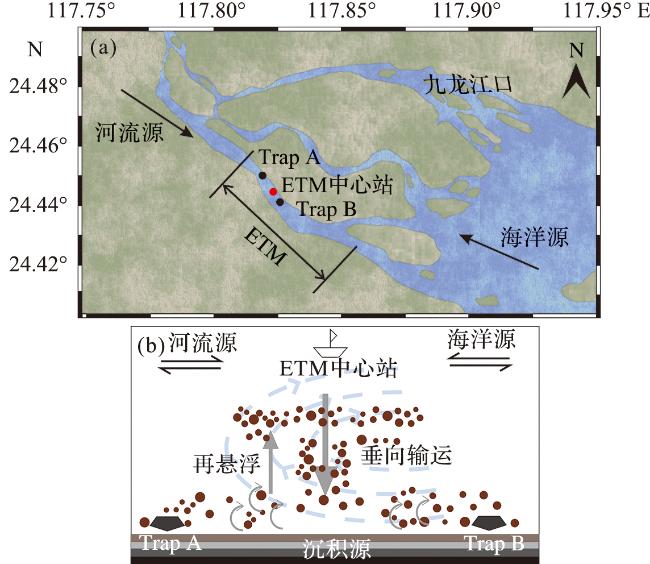
九龙江口是福建省第二大河流九龙江的入海口(图1a)。该河口汇集了北溪、西溪和南溪三大支流,并于厦门港附近注入台湾海峡。九龙江口平均潮差为3.8 m,最大潮差可达6.2 m,为不规则半日潮[17]。九龙江是山溪性河流,年均径流量约为1.2×10¹⁰ m2,年输沙量约为2.5×10⁹ kg[18]。受季风、降雨影响,九龙江径流呈现显著季节性差异,其中枯水季(11月—4月)径流量约占全年的30%,输沙量低于全年其他时期[19]。受到强烈的潮汐混合、泥沙再悬浮和盐水楔的共同作用,该河口区发育了典型的ETM。在正常情况下,ETM区域的悬沙质量浓度范围为0.03~0.40 kg·m-3[20]。受涨、落潮和降雨影响,九龙江口ETM的位置会在图1a所示范围内迁移。
图1 九龙江口ETM概况及采样站位设置图(a)以及ETM内POC主要输运过程和河口环流示意图

(图1a中的Trap A和Trap B表示沉积物捕获器站位,图1b中的带箭头虚线表示河口环流。)

Fig.1 Overview of the estuarine turbidity maximum (ETM) at the Jiulong River Estuary and sampling stations (a), and the schematic diagram of the main POC transport processes and estuarine circulation within the ETM

(In Fig.1a, Trap A and Trap B represent sediment trap stations. In Fig.1b, the dashed lines with arrows indicate estuarine circulation.)

2 方法与材料

2.1 现场观测与样品收集

本研究于枯水期的2018年11月29日12:00至30日12:00,在九龙江口ETM区域内开展了24 h连续观测与采样工作。采样站点包括ETM中心站和两个沉积物捕获器站(Trap A站位于中心站的河流一侧,Trap B站位于中心站的海洋一侧,Trap A和Trap B站之间的距离小于200 m,见图1)。在ETM中心站进行24 h定点观测,每小时采集CTD数据、表层和底层水样以及表层沉积物,覆盖两个完整潮周期;沉积物捕获器获取小时分辨率的垂向沉降颗粒样品,连续采样24 h,具体情况如下。
1)水文参数:在中心站使用CTD(Sea & Sun Technology CTD 48M)观测全水柱的水深、温度和盐度。在Trap B站使用1台频率为1 200 kHz的声学多普勒流速剖面仪(acoustic Doppler current profiler,ADCP)观测剖面流速,流速正值表示涨潮流(向陆),负值表示落潮流(向海)。为便于讨论,本文的“表层水温”和“底层水温”分别为CTD数据中距水面0.8 m处和距底1.0 m处的水温; “表层平均流速”和“底层平均流速”分别为ADCP数据中距水面0.8 m水层和距底1.0 m水层的流速平均值;“剖面平均流速”则为ADCP数据中全水柱的流速平均值。
2)水平输运悬浮颗粒:表层水样取自水深约0.8 m处,底层水样取自距海床约0.5 m处。利用钢化玻璃采水器采集表、底层水样后,分别从各层水样中取100~200 mL,现场立即利用已知干重的玻璃纤维滤膜(Whatman GF/F 0.7 μm)进行过滤,并将滤膜冷藏保存。
3)垂向沉降颗粒:在Trap A和Trap B站各布设一个坐底式沉积物捕获器(HYDRO-BIOS438115多通道捕获器),其采样漏斗口距海床约0.5 m,用以采集沉降颗粒样品。样品冷藏保存。
4)ETM表层沉积物:使用抓斗式采样器在ETM中心站采集表层沉积物样品。

2.2 有机碳及其同位素实验室分析

水平输运悬浮颗粒(膜样)预处理:滤膜经冷冻干燥后,称取其总质量,扣除滤膜质量获得总悬浮颗粒物干质量。随后,将称重后的滤膜放入培养皿中,逐滴加入1 mol·L-1的盐酸至完全浸没,于通风橱内静置反应16 h。反应结束后,将其放入50 ℃烘箱中干燥48 h。最后,将处理后的滤膜用锡杯包裹并压制成球状。
垂向沉降颗粒和表层沉积物样品预处理:样品经冷冻干燥后,称取1 g左右置于50 mL离心管中,加入10 mL 1 mol·L-1的盐酸,于通风橱中静置反应16 h,以去除碳酸盐。随后,使用去离子水反复清洗样品直至溶液呈中性,再次冷冻干燥48 h。之后,用玛瑙研钵将样品研磨至200目以下,并称取50 mg左右粉末样品,密封于锡杯中待测。
预处理后的样品送至香港大学地球与行星科学系,利用元素分析-稳定同位素质谱联用仪(EA-IRMS: Flash EA 1112, Thermo Scientific联用Delta V Advantage, Thermo Scientific)测定样品中的总有机碳含量ω(TOC)、总氮含量ω(TN)和稳定碳同位素组成(δ13C),计算TOC和TN的摩尔比(C/N值)。δ13C的分析误差为±0.2‰,ω(TOC)与ω(TN)的分析误差均为±0.8‰。

2.3 数据分析

2.3.1 总悬浮颗粒物(TSM)质量浓度的计算

ρ(TSM)=M/V
式中:ρ(TSM)为总悬浮颗粒物质量浓度(单位:mg·L-1),M为总悬浮颗粒物的干质量(单位:mg),V为过滤水样的对应水体体积(单位:L)。

2.3.2 表、底层水样中POC质量浓度的计算

ρ(POC)=ρ(TSM)×ω(TOC)
式中:ρ(POC)为水样中POC的质量浓度(单位:mg·L-1),ω(TOC)为总有机碳在总悬浮颗粒物中的质量百分比。

2.3.3 颗粒沉降通量的计算

颗粒沉降通量=W/(S×T)
式中:W为每小时捕集的颗粒干质量(单位:mg),S为沉积物捕获器收集漏斗面积(单位:cm2),T为单瓶采样持续时间(本研究中为1 h),颗粒沉降通量的单位为mg·cm-2·h-1

2.3.4 ETM内不同来源POC贡献的计算原理与方法

研究区ETM内POC来源为河流源、海洋源和沉积源三个端元。本研究选择基于δ13C和N/C值的三端元线性模型[21],采用蒙特卡洛计算机模拟策略进行4 000 000次随机抽样(在Python 3.10中运行),估算不同端元的贡献比例:
$\left[\begin{array}{lll}{\delta }^{13}{C}_{riverine}& {\delta }^{13}{C}_{marine}& {\delta }^{13}{C}_{sedimentary}\\ N/{C}_{riverine}& N/{C}_{marine}& N/{C}_{sedimentary}\\ 1& 1& 1\end{array}\right]$· $\left[\begin{array}{l}\alpha \\ \beta \\ \gamma \end{array}\right]$= $\left[\begin{array}{l}{\delta }^{13}{C}_{sample}\\ N/{C}_{sample}\\ 1\end{array}\right]$
式中:αβγ分别代表河流源、海洋源和沉积源中POC的贡献率(0≤α,β,γ≤1),各端元的δ13C和N/C值见表1。本文仅在端元模型中使用N/C值,以消除TOC效应,除此之外均使用C/N值以更直观判断有机碳来源。
表1 九龙江口主要POC端元的δ13C和N/C值

Tab.1 The δ13C and N/C values of POC endmembers of Jiulong River Estuary

端元 δ13C/‰ N/C值 数据来源
海洋源 -20.0±1.0 0.15±0.05 文献[5]
河流源 -25.3±1.5 0.17±0.05 文献[19]
沉积源 -25.6±1.6 0.07±0.01 本研究
需要说明的是,本研究中沉积源POC实际上是河流源(河流悬浮POC)、海洋源(海洋悬浮POC)和陆源(土壤、河流沉积物中的POC)共同作用的产物,其端元值可能与本研究选用的河流源、海洋源存在一定重叠,从而引入了端元占比计算的不确定性。本文中的端元分析旨在评估各个来源的相对贡献比例,而非绝对贡献量;同时,沉积源POC的同位素特征和输运机制又显著区别于其他端元,因此该分析仍能够为解析ETM中POC的源-汇过程提供有效支撑。

2.3.5 盐度层化系数的计算

盐度层化系数=(Ss-Sb)/S0
式中:Ss为表层水盐度,Sb为底层水盐度,S0为垂线平均盐度。

2.3.6 经验正交函数分析

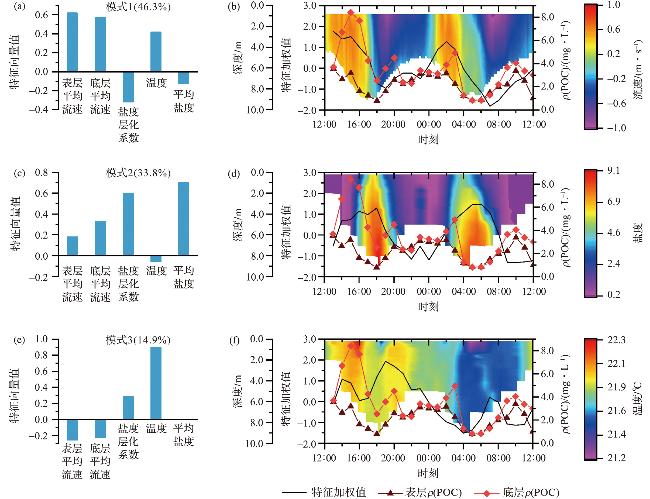
经验正交函数(empirical orthogonal function,EOF)分析是一种多变量统计方法,通过将时空相关数据分解为数学上正交的模态,以识别其主导的变化结构。目前,该方法已广泛应用于海洋学研究领域[22-23]。本研究采用Python 3.10对研究区定点观测的5个水文参数(包括表层流速、底层流速、水温、平均盐度和盐度层化系数)进行EOF分析,旨在探讨不同环境因子与POC物源组成及其行为特征之间的相关性。

3 结果

3.1 九龙江口ETM水文参数观测结果

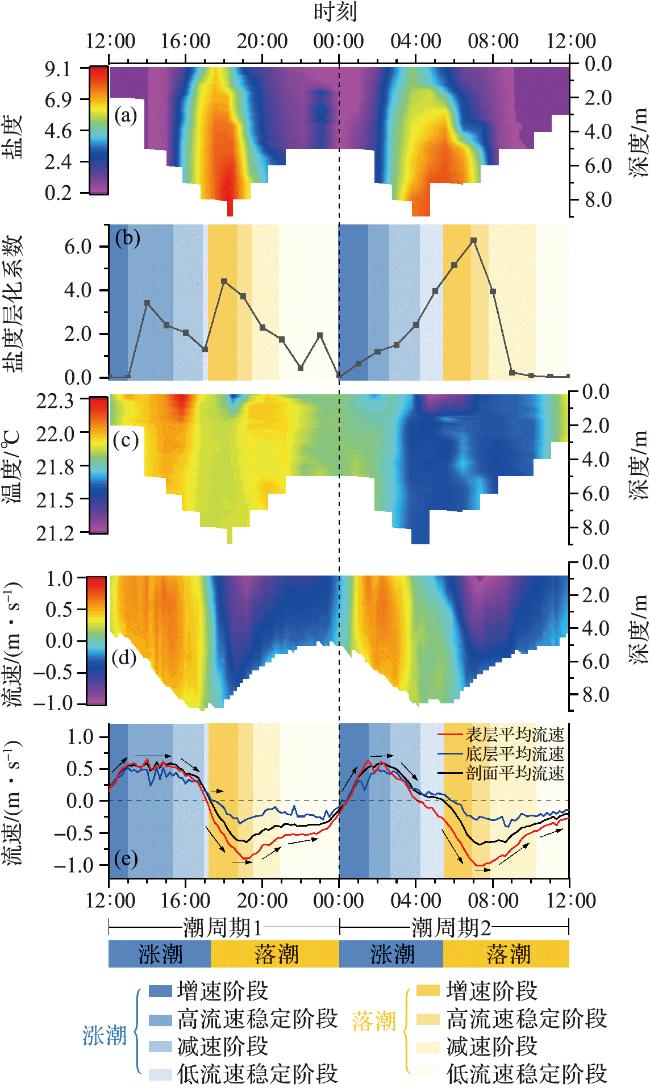
本次观测从2018年11月29日12:00(最低潮时)开始,覆盖两个完整的潮周期,记作潮周期1和潮周期2。观测结果显示:研究区低平潮时最小水深约2.0 m,高平潮时最大水深约9.0 m,最大潮差约7.0 m。涨潮阶段,盐度最大可达9.1;落潮阶段,盐度下降,最小值<0.2(图2a)。盐度层化系数与水深在潮周期2中呈一定的正相关关系,且涨潮阶段较落潮阶段显著,但二者在潮周期1中则无显著相关关系(图2a2b)。表层水温为21.2~22.3 ℃,底层水温为21.5~21.9 ℃;表层水温整体略高于底层(图2c)。
图2 两个潮周期内ETM的水文参数观测结果

(a:盐度;b:盐度层化系数;c:CTD测得的水温;d:ADCP测得的潮流 剖面速度;e:潮流平均流速,其中剖面平均流速为对应时刻ADCP 测得全水柱流速的平均值。)

Fig.2 Observation results of ETM hydrological parameters in two tidal cycles

(a: salinity; b: salinity stratification coefficient; c: temperature measured by CTD; d:tidal current profile velocity measured by ADCP; e: average velocity of tidal current, where the profile-averaged velocity is the average value of total water column velocity measured by ADCP at the corresponding time.)

潮流剖面流速范围为-1.0~0.7 m·s-1,其中落潮流速高于涨潮流速(图2d)。根据潮流流速的变化趋势(图2d图2e),将每个涨潮期和落潮期划分为四个阶段(详见图2图例):1)增速阶段:该阶段流速由零增至最大值;2)高流速稳定阶段:流速在最大值保持相对稳定;3)减速阶段:流速由最大值逐渐减小至最小值;4)低流速稳定阶段:流速继续减小,直至为零。
表层平均流速在-1.0~0.6 m·s-1之间,底层平均流速在-0.5~0.5 m·s-1之间。涨潮阶段,表、底层平均流速差异较小;落潮阶段,表层平均流速整体上大于底层平均流速(图2e)。尽管两个潮周期的流速范围相近,但其涨、落潮各阶段的持续时间存在明显差异。例如涨潮阶段,潮周期1的高流速稳定阶段持续了约2.5 h,但在潮周期2中仅约1.0 h(图2e)。

3.2 总悬浮颗粒有机碳质量浓度及其同位素特征

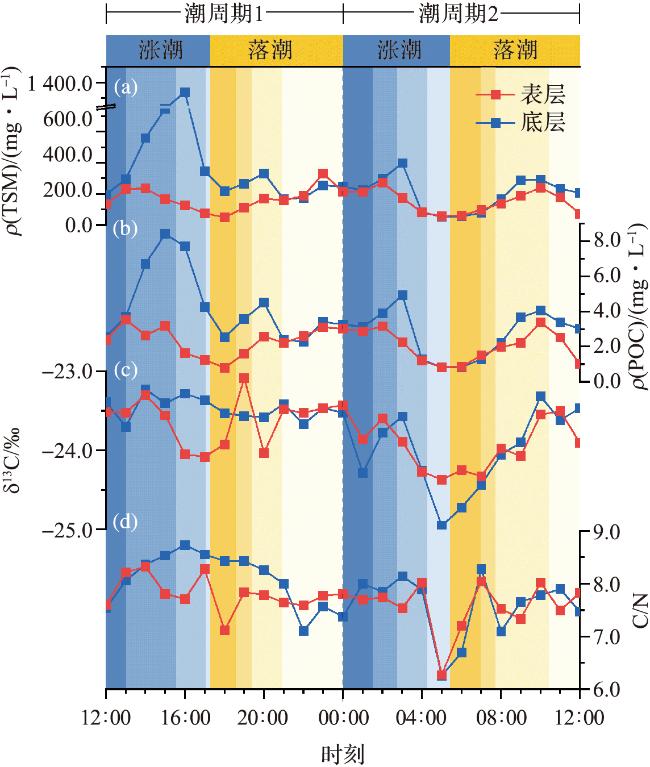
ETM内表层TSM和POC质量浓度(TSM:50.9~330.0 mg·L-1,POC:0.8~3.6 mg·L-1)整体低于底层(TSM:53.6~1 337.3 mg·L-1,POC:0.8~8.4 mg·L-1)(图3a3b)。在涨潮阶段(图3中蓝色条带)的高流速稳定阶段结束或减速阶段开始时,底层TSM和POC质量浓度达到峰值,表层与底层的TSM和POC质量浓度相差最大。例如,在潮周期1中,该阶段的TSM质量浓度在表层为127.0 mg·L-1,在底层为1 337.3 mg·L-1;POC质量浓度在表层为3.2 mg·L-1,在底层为8.4 mg·L-1。落潮阶段(图3中黄色条带)表层和底层的TSM和POC质量浓度则较为接近。潮周期1和潮周期2的TSM和POC质量浓度变化趋势类似,但潮周期1的TSM和POC质量浓度整体高于潮周期2。
图3 ETM内表、底层总悬浮颗粒有机碳质量浓度及其同位素特征

(背景渐变色图例同图2。)

Fig.3 Organic carbon mass concentration and isotopic characteristics of total suspended particulate matter in the surface and bottom of ETM

(The background gradient color legend follows the same scheme as in Fig.2.)

ETM内,表层POC的δ13C值在-24.4‰~-23.1‰内波动,C/N值在6.3~8.3之间;底层POC的δ13C值在-25.0‰~-23.2‰内波动,C/N值在6.3~8.7之间。涨潮阶段表层POC的δ13C值和C/N值整体低于底层,潮周期1内表层和底层之间的差异大于潮周期2(图3c3d)。

3.3 沉降颗粒有机碳沉降通量及其同位素特征

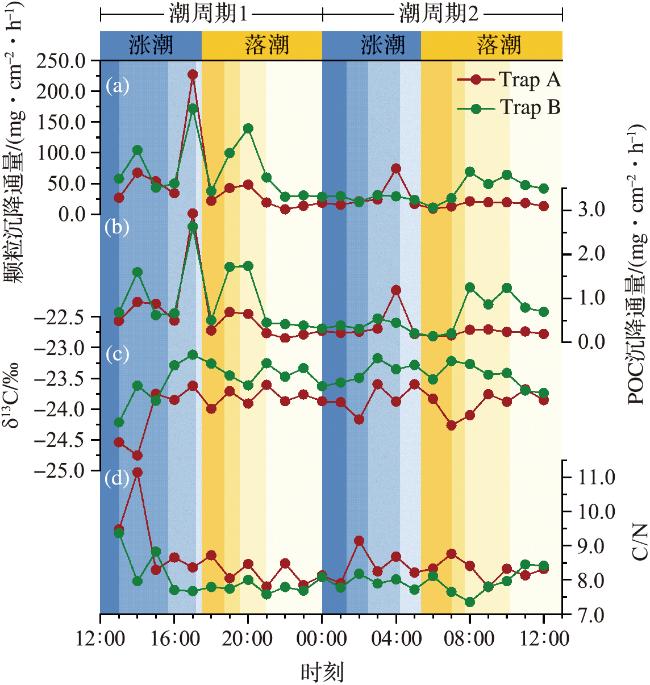
沉积物捕获器A和B中测得的平均颗粒沉降通量分别为35.3 mg·cm-2·h-1和53.9 mg·cm-2·h-1。整体来看,潮周期1的沉降通量高于潮周期2,颗粒沉降通量在潮周期1的涨潮末期出现峰值,此时捕获器A和B中的颗粒沉降通量分别为227.1 mg·cm-2·h-1和171.6 mg·cm-2·h-1(图4a)。捕获器A和B的平均POC沉降通量分别为0.5 mg·cm-2·h-1和0.8 mg·cm-2·h-1(图4b)。
图4 沉积物捕获器中颗粒沉降通量及其同位素值

(背景渐变色图例同图2。)

Fig.4 Sinking particle flux and its isotopic values from sediment traps

(The background gradient color legend follows the same scheme as in Fig.2.)

图4c4d所示,沉积物捕获器B中沉降颗粒的δ13C值(-24.2‰~-23.1‰)整体高于捕获器A的δ13C值(-24.8‰~-23.6‰),而C/N值(7.4~9.4)整体低于捕获器A中的C/N值(7.8~11.1)。其中,捕获器A在潮周期1内约14:00时记录到C/N峰值(11.1),为所有观测中的最大值(图4d)。

3.4 基于蒙特卡洛模型的端元分析结果

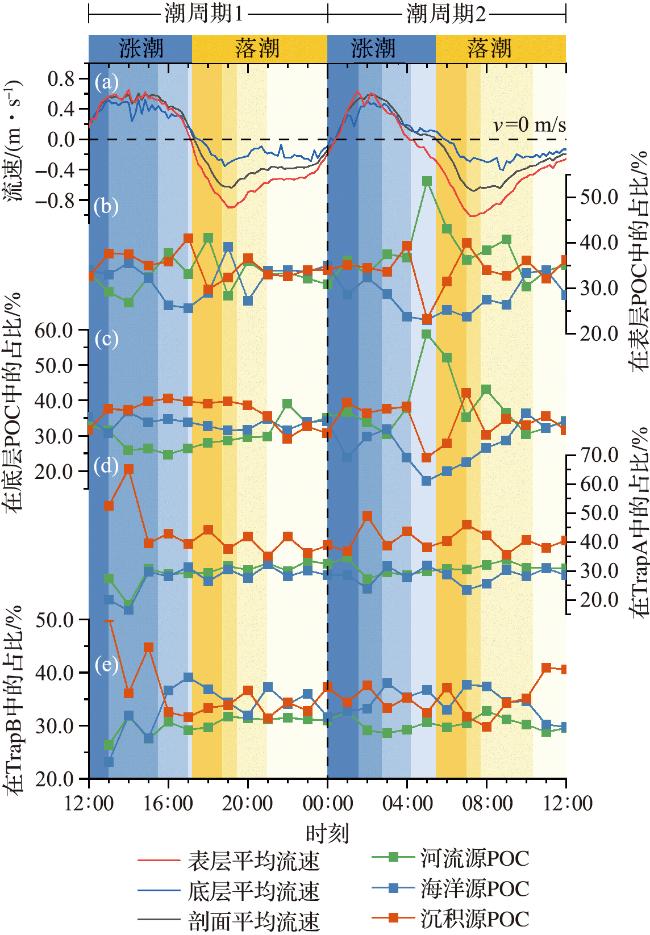
本研究基于δ13C和N/C值特征(表1)的蒙特卡洛端元模型估算ETM内POC不同来源占比的结果如图5所示。
图5 通过三端元模型模拟的不同来源POC贡献率结果

(背景渐变色图例同图2。)

Fig.5 Simulation result of POC contribution rates from different sources via the MC-based three-endmember modelling

(The background gradient color legend follows the same scheme as in Fig.2.)

表层POC中,河流源POC的平均贡献率最大(35.5%),沉积源POC次之(34.2%),最后为海洋源POC(30.3%)(图5b);底层POC中,沉积源POC的平均贡献率最大(35.1%),河流源POC次之(34.4%),最后为海洋源POC(30.5%)(图5c)。表层和底层POC中的三端元占比均随潮周期过程变化而变化。如在潮周期1的涨潮高流速稳定阶段,表、底层POC中,均为沉积源POC占比最大,河流源POC占比最小;而在潮周期2的涨潮低流速稳定阶段,则是河流源POC占比最大,其次为沉积源POC。
沉降颗粒样品(Trap A和Trap B)均以沉积源POC为主导(图5d5e)。其中,Trap A站沉降POC中沉积源POC的平均贡献率为41.9%,河流源POC次之(30.2%),最后为海洋源POC(27.9%)(图5d);Trap B站沉降POC中沉积源POC的平均贡献率为35.8%,其次是海洋源POC(33.9%),最后为河流源POC(30.3%)(图5e)。沉积源POC贡献率均在潮周期1的涨潮高流速稳定阶段达到峰值,Trap A站为65%,Trap B站为50%。

3.5 EOF分析结果

通过对表层和底层平均流速、水温、平均盐度、盐度层化系数的EOF分析,得到3个主要模式(模式1~模式3)。模式1解释了总空间相关性的46.3%,为主导模式,且与底层TSM、表层POC和底层POC质量浓度均有显著正相关关系(表2图6b)。模式1的5个变量中,表、底层平均流速的特征向量值较大,分别为0.62和0.58(图6a)。图6b进一步展示了模式1中的流速变量与表、底层POC质量浓度时间序列的正相关关系,说明潮流流速是控制POC质量浓度的最重要变量。模式2解释了总空间相关性的33.8%,与表层TSM和表层POC质量浓度均呈显著负相关关系(表2图6d)。模式2的5个变量中,平均盐度的特征向量值最大,为0.71(图6c),表明盐度增大对表层颗粒物质量浓度有稀释效应。模式3解释了总空间相关性的14.9%,与TSM和POC质量浓度均无显著相关性(表2图6f)。
表2 EOF分析主要模式的特征值与TSM和POC质量浓度之间的皮尔逊相关系数

Tab.2 Pearson correlation coefficient between EOF characteristic weighted parameter and TSM and POC mass concentration

主要模式 质量浓度
表层TSM 底层TSM 表层POC 底层POC
模式1 0.38 0.55* 0.47* 0.66*
模式2 -0.56* 0.17 -0.58* 0.01
模式3 0.02 0.20 0.06 0.29

注:*表示具有显著相关性,显著性水平为p<0.01。

图6 EOF分析结果

(图6a、6c6e分别展示了模式1~模式3的5个变量的特征向量值。图6b、6d6f分别展示了模式1~模式3特征加权值的时间序列及其与表、底层POC质量浓度时间序列的对比关系;其中的背景分别为模式1~模式3对应的特征向量值最显著的变量剖面值。)

Fig.6 Results of EOF analysis

(Figures 6a, 6c, and 6e show the EOF loadings values of the five variables for Mode 1 to Mode 3, respectively. Figures 6b, 6d, and 6f display corresponding principal component (PC) time series for each mode, compared with the time series of surface and bottom POC mass concentrations. The background in these subplots shows the depth profiles of the variable with the highest absolute loading in each respective mode.)

4 讨论

4.1 潮流流速对POC质量浓度和物源的影响

受涨、落潮影响,ETM内POC主要包括径流带来的河流源POC、潮流带来的海洋源POC和再悬浮作用起动的ETM内沉积源POC[24](图1b)。本研究结果指示,潮流流速是调控ETM内POC质量浓度和物源变化的关键因子,该现象与大型河口研究结果一致[25-26]。此外,本研究还进一步揭示了潮流流速调控ETM内POC质量浓度和物源变化的主要机制。
首先,潮流流速大小和持续时间是调控沉积源POC“起动-再悬浮-沉降平衡”的首要因素。高流速阶段,流速>0.5 m·s-1,满足九龙江口沉积物的起动流速(0.5~0.8 m·s-1)[27],使沉积物发生再悬浮,从而沉积源POC占比显著增加,其在沉降POC中的最高占比可达65%(图5d)。这表明高流速持续时间通过调控沉积物再悬浮及POC的悬浮时间,进而调控POC质量浓度。如潮周期1的高流速持续时间约为2.5 h,沉积源POC的贡献率显著高于潮周期2(高流速持续时间约为1.0 h)(图5)。低流速阶段,悬浮颗粒垂向沉降,沉降通量在低流速稳定阶段达到峰值(图4a)。此规律在其他大型河口也普遍存在[7,26,28-29]
其次,涨、落潮引起的潮流速度改向决定了ETM内咸、淡水团的主导性,从而决定河流源POC和海洋源POC的占比变化。涨潮时,潮流速度向陆,相对高盐、低POC质量浓度的海水自底层入侵ETM,这是海洋源POC输入的主要途径,并通过河口环流作用到达表层,对表层淡水POC起到“稀释”作用,导致表层POC质量浓度随涨潮过程逐渐降低(图3b);落潮时,潮流速度向海,低盐、高POC质量浓度的淡水占据ETM,整体POC质量浓度随落潮过程逐渐上升(图3b)。此外,涨潮流直接作用于海床,其高流速引起的沉积物再悬浮,往往导致沉积源POC占比增加,且显著高于落潮高流速阶段。
最后,流速层化强度控制着POC的垂向混合程度。涨、落潮流速层化加剧时(如涨、落潮高流速稳定阶段和减速阶段,图5a),水体垂向混合减弱,表层与底层POC质量浓度差异增大(存在约1.0 h的时间滞后效应,图3a3b)。就涨、落潮的高流速层化阶段而言,涨潮高流速稳定阶段和减速阶段的层化强度远低于落潮强层化阶段(图5a),因此流速层化对沉积源POC表层扩散的抑制作用在落潮阶段更为显著,如表层POC中沉积源POC占比仅在涨潮阶段起主导。这一现象进一步证明了流速层化对POC垂向混合的控制作用[30-31]

4.2 ETM内不同潮汐阶段POC的输运模型

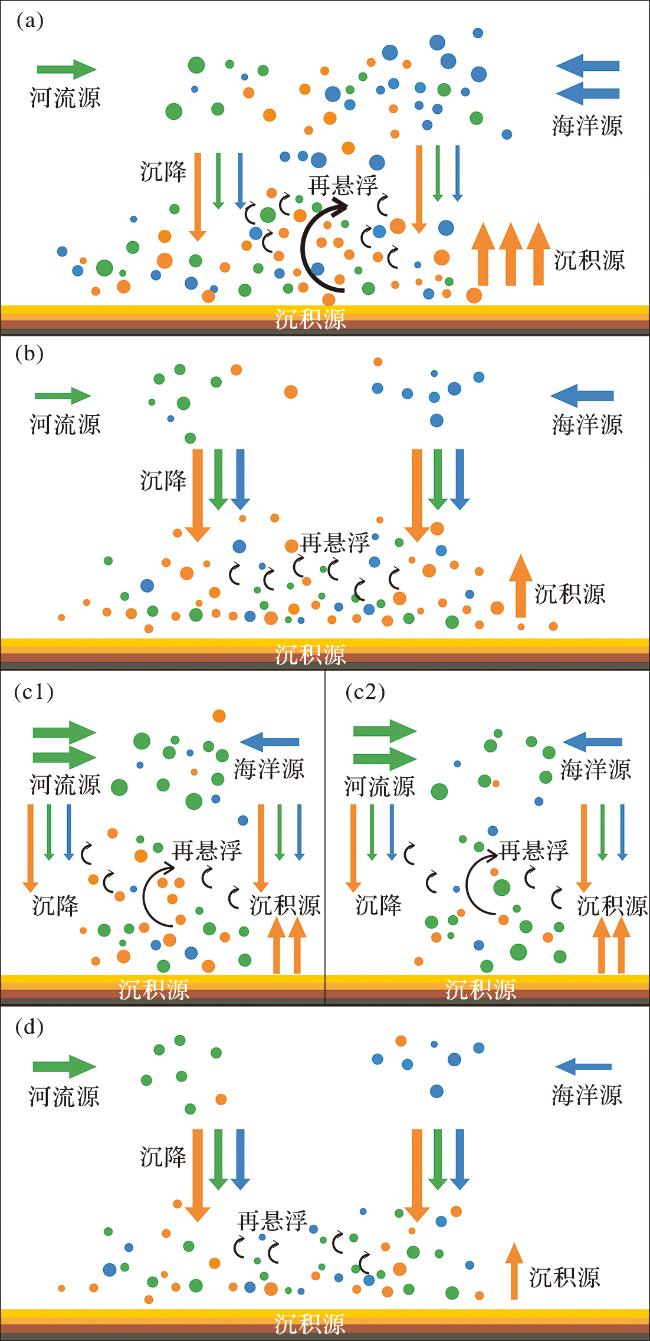
基于上述分析,本研究从潮流流速调控POC来源和输运过程的角度,总结了ETM内不同潮汐阶段POC的输运模型(图7)。
图7 不同潮汐阶段ETM内POC随潮流速度变化的输运模式示意图

(a:涨潮期;b:高平潮期;c:落潮期,其中c1的前序涨潮期高流速持续时长较c2的长;d:低平潮期。箭头的颜色和方向代表不同动力和POC输运过程:绿色为落潮过程(水平箭头)和河流源POC沉降(垂向箭头),蓝色为涨潮过程(水平箭头)和海洋源POC沉降(垂向箭头),橙色箭头为沉积源POC的再悬浮或沉降(垂向箭头),黑色箭头为再悬浮过程。箭头的数量与粗细代表不同过程的强弱程度:箭头数量愈多、越粗,代表该过程强度越强。圆点颜色代表不同来源POC:绿色圆点为河流源POC,蓝色圆点为海洋源POC,橙色圆点为沉积源POC。圆点数量的相对多寡,指示了不同物源POC的相对占比大小,数量越多表示相对占比越高。但圆点尺寸仅为不同粒径颗粒组成的定性示意,不表征不同粒径颗粒的具体定量占比。)

Fig.7 Conceptual schematics of POC transport processes at different tide stages within the ETM

(a: flood tide stage; b: high-slack tide stage; c: ebb tide stage, with the duration of high flow velocity during the pre-flood tide phase in c1 longer than that in c2; d:low-tide slack tide stage. The different colors and directions of the arrows represent different dynamic processes and POC transport pathways: green arrows denote the ebb tide process (horizontal) and the sinking of riverine POC (vertical), blue arrows denote the flood tide process (horizontal) and the sinking of marine POC (vertical), orange arrows denote the sinking of sedimentary POC (vertical), and black arrows denote the resuspension process. The number and thickness of the arrows indicate the strength of these processes: more and thicker arrows represent a stronger intensity of the process. The dot color represents different sources of POC: green dots denote fluvial POC, blue dots denote marine POC, and orange dots denote sedimentary POC. The dot number presents the relative contribution of different sources of POC. The more dots present the higher the relative proportion. However, the dot dimensions serve only as a qualitative illustration of the multi-sized particle composition, not as a measure of their proportional distribution.)

涨潮期(图7a),受潮流驱动,海洋源POC在表层和底层水体中的占比呈现先增后减的趋势。虽然此阶段海洋源POC整体贡献率相较于其他时期更高,但沉积源POC始终在本阶段的POC来源构成中占优势。
高平潮期(图7b),随着潮流速度减弱至最低点(或趋近于零),不同来源的POC主要表现为沉降作用。沉积源POC继续保持其主导优势,尤其是在经历了涨潮期沉积源POC快速添加后的高平潮期,这一趋势更加突出。若前序涨潮期的高流速阶段持续时间较长,这种沉积源POC的主导性会得到进一步强化。
落潮期(图7c),径流驱动的河流源POC迅速增加,且表层高流速对沉积源POC添加作用有限,不同来源POC贡献率的变化与前序涨潮期高流速持续时间紧密相关:当前序涨潮期高流速持续时间较长时,后续落潮阶段,沉积源POC质量浓度高,靠沉降过程引起的稀释缓慢,ETM对径流驱动的河流源POC输入不敏感,故底层POC仍以沉积源POC为主(图7c1),而河流源POC仅在落潮低流速稳定期与沉积源POC贡献率持平或略高。反之,当前序涨潮期高流速持续时间较短时,沉积源POC原本就相对较少,沉降之后浓度稀释效应显著,ETM内POC对落潮流带来的河流源POC显得更加敏感(图7c2),故后续落潮阶段POC由河流源POC占主导。
低平潮期(图7d),类似高平潮期,亦以颗粒物沉降为主导。然而,由于前序落潮期间的表层高流速主要引入了河流源POC,而对沉积源POC的添加作用有限,从而为河流源POC占比的上升(乃至占据相对优势)创造了条件。最终,三种物源的POC比例在整体上相当。
此外,ETM区域动态的水动力环境也可能扮演“碳反应炉”的角色[32]。频繁的“再悬浮-沉降”循环使得POC反复暴露在氧化性不同的水体和沉积物环境中,这可能显著影响有机碳的降解速率和保存效率[33]

5 结论

本研究以福建九龙江河口最大浑浊带为研究对象,开展了两个潮周期内小时分辨率的POC源-汇过程及其驱动机制研究,得到以下主要结论。
1)潮流流速是调控九龙江口ETM内POC来源与输运的关键因子,通过其大小、方向和持续时间影响着POC的水平输运、再悬浮作用和垂向混合过程,从而调控POC的物源组成和质量浓度。具体表现为:潮流流速与POC质量浓度呈显著正相关,高潮流流速引发的沉积物再悬浮是沉积源POC的主要驱动因素;涨、落潮交替变化是河流源和海洋源POC交替的主要因素;流速层化(尤其落潮期)则控制着不同来源POC的垂向混合强度。
2)基于潮流速度对POC源-汇过程的影响,本研究总结了不同潮汐阶段ETM内POC的输运模型:涨潮期以高涨潮流速驱动的沉积源为主导;低流速的高平潮期以沉降过程为主,但沉积源POC仍占主导,且前序涨潮高流速时间持续越长,该现象越显著;落潮期,流速加大,但再悬浮作用不及涨潮期,整体以河流源添加为主,但不同来源POC占比情况受前序涨潮期高流速持续时长影响显著;低平潮期,低流速促使颗粒以沉降过程为主,整体上三种物源POC占比相当。
本研究深化了对山溪性河流河口ETM内POC源-汇过程的认识,揭示了潮流流速对ETM内POC行为的重要调控作用,是进一步深入研究陆海碳循环的基础。

感谢厦门大学程鹏教授提供CTD和ADCP现场观测数据及数据分析方面的支持,感谢自然资源部第三海洋研究所王爱军教授提供沉积物捕获器支持,感谢程章宇、夏天、高成成、庄自贤等同学野外采样,感谢香港大学宗永强教授提供样品测试帮助,感谢台湾国立中山大学刘祖乾教授提供宝贵修改意见。

[1]
姚冠荣, 高全洲. 河流碳循环对全球变化的响应与反馈[J]. 地理科学进展, 2005, 24(5):50-60.

YAO G R, GAO Q Z. The feedback and response of the riverine carbon cycle to global changes[J]. Progress in Geography, 2005, 24(5): 50-60.

DOI

[2]
LUDWIG W, PROBST J L, KEMPE S. Predicting the oceanic input of organic carbon by continental erosion[J]. Global Biogeochemical Cycles, 1996, 10(1): 23-41.

DOI

[3]
LI P, YANG S L, MILLIMAN J D, et al. Spatial, temporal, and human-induced variations in suspended sediment concentration in the surface waters of the Yangtze Estuary and adjacent coastal areas[J]. Estuaries and Coasts, 2012, 35(5): 1316-27.

DOI

[4]
SUN X S, FAN D, LIAO H, et al. Fate of organic carbon burial in modern sediment within Yangtze River Estuary[J]. Journal of Geophysical Research: Biogeosciences, 2020, 125(2): e2019JG005379.

[5]
CHENG Z Y, YU F L, RUAN X Y, et al. GDGTs as indicators for organic-matter sources in a small subtropical river-estuary system[J]. Organic Geochemistry, 2021, 153: 104180.

DOI

[6]
ETCHEBER H, TAILLEZ A, ABRIL G, et al. Particulate organic carbon in the estuarine turbidity maxima of the Gironde, Loire and Seine estuaries: Origin and lability[J]. Hydrobiologia, 2007, 588(1): 245-59.

DOI

[7]
MCCANDLISS R R, JONES S E, HEARN M, et al. Dynamics of suspended particles in coastal waters (southern North Sea) during a spring bloom[J]. Journal of Sea Research, 2002, 47(3): 285-302.

DOI

[8]
ZHU Z Y, ZHANG J, WU Y, et al. Bulk particulate organic carbon in the East China Sea: Tidal influence and bottom transport[J]. Progress in Oceanography, 2006, 69(1): 37-60.

DOI

[9]
叶君, 姚鹏, 徐亚宏, 等. 长江口盐度梯度下不同形态碳的分布、来源与混合行为[J]. 海洋学报, 2019, 41(4):15-26.

YE J, YAO P, XU Y H, et al. Distribution, sources and mixing behavior of different carbon species along a salinity gradient in the Changjiang Estuary[J]. Haiyang Xuebao, 2019, 41(4): 15-26.

[10]
邢建伟, 线薇微, 绳秀珍. 春、冬季长江口颗粒有机碳的时空分布及输运特征[J]. 中国环境科学, 2014, 34(9):2380-2386.

XING J W, XIAN W W, SHENG X Z. Spatial-temporal distribution and transportation of particulate organic carbon in the Yangtze River Estuary in spring and winter 2012[J]. China Environmental Science, 2014, 34(9): 2380-2386.

[11]
张龙军, 张向上, 王晓亮, 等. 黄河口有机碳的时空输运特征及其影响因素分析[J]. 水科学进展, 2007, 18(5):674-682.

ZHANG L J, ZHANG X S, WANG X L, et al. Spatial and temporal distribution of particulate and dissolved organic carbon in Yellow River estuary[J]. Advances in Water Science, 2007, 18(5): 674-682.

[12]
LU T A, BIANCHI T S, BI N S, et al. Particulate organic carbon dynamics off the Yellow River Estuary revealed by in situ hydrodynamics and carbon isotopes[J]. Marine Geology, 2025, 487: 107591.

DOI

[13]
GAO C C, YU F L, CHEN J X, et al. Anthropogenic impact on the organic carbon sources, transport and distribution in a subtropical semi-enclosed bay[J]. Science of The Total Environment, 2021, 767: 145047.

DOI

[14]
KHOJASTEH D, RAO S, MCSWEENEY S, et al. Intermittent estuaries deserve global attention as vulnerable and vital ecosystems[J]. Communications Earth & Environment, 2025, 6: 443.

[15]
龚松柏, 高爱国, 林建杰, 等. 闽江下游及河口沉积物总碳的地球化学特征[J]. 应用海洋学学报, 2018, 37(3):321-329.

GONG S B, GAO A G, LIN J J, et al. Geochemical characteristics of total carbon in sediments of the lower reaches of Minjiang and its estuary[J]. Journal of Applied Oceanography, 2018, 37(3): 321-329.

[16]
LU T A, WANG H J, HU L M, et al. Dynamic transport of particulate organic carbon in the Yellow River during dam-orientated water-sediment regulation[J]. Marine Geology, 2023, 460: 107054.

DOI

[17]
JIANG Y W, WAI O W H. Drying-wetting approach for 3D finite element sigma coordinate model for estuaries with large tidal flats[J]. Advances in Water Resources, 2005, 28(8): 779-792.

DOI

[18]
WANG Y P, VOULGARIS G, LI Y, et al. Sediment resuspension, flocculation, and settling in a macrotidal estuary[J]. Journal of Geophysical Research: Oceans, 2013, 118(10): 5591-5608.

DOI

[19]
邹良荣. 九龙江流域及河口有机δ13C和C/N特征及其对POM物源与运移过程的指示意义[D]. 厦门: 厦门大学, 2018.

ZOU L R. Characteristics of organic δ13C and C/N in the Jiulong River Basin and Estuary and their indicative significance for POM source and transport processes[D]. Xiamen: Xiamen University, 2018.

[20]
赵洪波, 张庆河, 许婷. 九龙江河口湾港区水沙运动数值模拟研究[J]. 泥沙研究, 2015, 40(4):38-43.

ZHAO H B, ZHANG Q H, XU T. Numerical modeling of flow and sediment movement on Jiulongjiang Estuary harbor[J]. Journal of Sediment Research, 2015, 40(4): 38-43.

DOI

[21]
LIU K K, KAO S J. A three end-member mixing model based on isotopic composition and elemental ratio[J]. Terrestrial, Atmospheric and Oceanic Sciences, 2007, 18(5): 67.

[22]
LIU J T, LIU K J, HUANG J C. The effect of a submarine canyon on the river sediment dispersal and inner shelf sediment movements in southern Taiwan[J]. Marine Geology, 2002, 181(4): 357-386.

DOI

[23]
LIU D, BAI Y, HE X Q, et al. Satellite estimation of particulate organic carbon flux from Changjiang River to the estuary[J]. Remote Sensing of Environment, 2019, 223: 307-319.

DOI

[24]
YU F L, MA J Y, HUANG Z Q, et al. Sedimentary organic matters within the subtropical mountainous river-estuary-bay continuum: Provenances, fates and implications[J]. International Journal of Sediment Research, 2025. https://doi.org/10.1016/j.ijsrc.2025.07.005.

[25]
YANG Y P, LI Y T, WANG D. Transport mechanism of water and sediment in Yangtze River Estuary north-south branch bifurcation[J]. Applied Mechanics and Materials, 2013, 353-356: 2482-2486.

DOI

[26]
HAYAMI Y, WADA M, UMEZAWA Y, et al. Hypoxic water mass in the highly turbid well-mixed macrotidal Rokkaku River Estuary, Ariake Sea, Japan[J]. Estuarine, Coastal and Shelf Science, 2019, 219: 210-222.

DOI

[27]
王元领. 福建九龙江口洪枯季悬沙输运过程初步研究[D]. 青岛: 中国海洋大学, 2005.

WANG Y L. Initiative research on the transportation of suspended sediments in Jiulongjiang River Estuary, Fujian Province during flood and dry seasons[D]. Qingdao: Ocean University of China, 2005.

[28]
CLOERN J E, POWELL T M, HUZZEY L M. Spatial and temporal variability in South San Francisco Bay (USA). II. Temporal changes in salinity, suspended sediments, and phytoplankton biomass and productivity over tidal time scales[J]. Estuarine, Coastal and Shelf Science, 1989, 28(6): 599-613.

DOI

[29]
CHEN C A, LIU C T, CHUANG W S, et al. Enhanced buoyancy and hence upwelling of subsurface Kuroshio waters after a typhoon in the southern East China Sea[J]. Journal of Marine Systems, 2003, 42(1/2): 65-79.

DOI

[30]
GEYER W R. The importance of suppression of turbulence by stratification on the estuarine turbidity maximum[J]. Estuaries, 1993, 16(1): 113-125.

DOI

[31]
CHANT R J, GEYER W R, HOUGHTON R, et al. Estuarine boundary layer mixing processes: Insights from dye experiments[J]. Journal of Physical Oceanography, 2007, 37(7): 1859-1877.

DOI

[32]
GATTUSO J P, FRANKIGNOULLE M, WOLLAST R. Carbon and carbonate metabolism in coastal aquatic ecosystems[J]. Annual Review of Ecology and Systematics, 1998, 29: 405-434.

DOI

[33]
ABRIL G, COMMARIEU M V, ETCHEBER H, et al. In vitro simulation of oxic/suboxic diagenesis in an estuarine fluid mud subjected to redox oscillations[J]. Estuarine, Coastal and Shelf Science, 2010, 88(2): 279-91.

DOI

Outlines

/