



0 引言
1 研究区域概况
2 材料与方法
2.1 样品采集
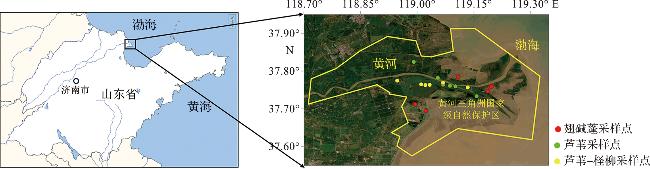
2021年6月,在黄河三角洲芦苇、芦苇-柽柳混生和翅碱蓬三种典型生境中分别布设采样站位,每种生境各设6个站位(图1)。在每个站位周围一定范围内采集3个深度为 20 cm的表层土壤样品,混合均匀后组成1个混合样品。样品采集后用450 ℃灼烧过的锡纸包裹,置于塑料封口袋中密封保存。
2.2 样品分析与数据处理
采用重量法测定土壤含水率,根据冷冻干燥前后土壤重量的差值计算水分含量。样品中的有机碳含量采用燃烧法测定,测定仪器为Vario Macro Cube元素分析仪,测定中采用的标准物质为苯丙氨酸(纯度为99%),标准曲线r2>0.999。δ13C测定采用MAT253稳定同位素质谱仪,土壤标准物质为B2153、USGS64和USGS40。
采用激光法测定样品粒度[17],检测仪器为Mastersizer 2000激光粒度仪,误差范围控制在±1%~±3%之间。按照粒径将土壤划分为三种组分,分别为黏土(<8 φ)、粉砂(4~8 φ)和砂(-1~4 φ)。土壤中Fe含量采用X-射线荧光光谱压片法测定,仪器为波长色散X射线荧光光谱仪,Fe含量以TFe2O3表示。
土壤木质素含量(Λ8)的测定参照文献方法[18],使用安捷伦5977B气质联用仪进行分析,标准曲线r2>0.999,木质素单体回收率为64%~83%。所测木质素单体包括丁香基酚(S系列)、香草基酚(V系列)、肉桂基酚(C系列)及对羟基酚(P系列)等。Λ8一般以S、V和C系列单体总量在土壤有机碳中的占比表示,单位为mg/(100 mg)(以OC计),下文简写为mg/(100 mg)。
建立了基于δ13C和木质素含量(Λ8)的三端元混合方程,并采用蒙特卡罗模型对方程求解,计算公式如下:
δ13C陆源× f1+δ13C海源× f2+δ13C植物源× f3=δ13C样品
f1+ f2+ f3=1
3 结果与分析
3.1 黄河口滨海湿地三种植被生境土壤的物化指标
研究区三种植被生境土壤样品的含水率为15.9%~36.2%,平均值为24.7%。其中芦苇生境土壤的含水率最高,平均值为27.9%;芦苇-柽柳和翅碱蓬生境土壤的含水率接近,平均值分别为23.2%和23.1%。
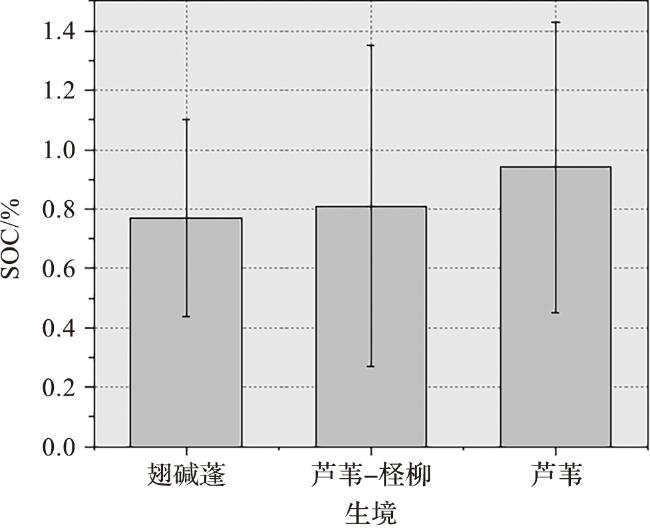
土壤有机碳含量为0.34%~1.85%,平均值为0.84%。芦苇生境土壤的有机碳含量最高(平均值为0.94%),其次是芦苇-柽柳生境土壤(平均值为0.81%),翅碱蓬生境土壤最低(平均值为0.77%)(图2)。
土壤δ13C的变化范围是-28.60‰~-22.10‰,平均值为-24.77‰。其中,翅碱蓬生境土壤的δ13C值最高(-24.03‰),芦苇-柽柳生境土壤(-24.79‰)和芦苇(-25.49‰)的δ13C值较低。
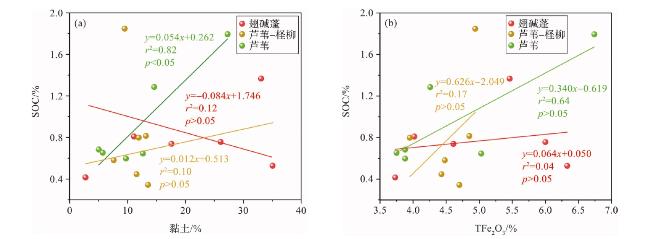
三种植被生境的土壤均以粉砂和砂质粉砂为主,黏土组分(<8 Φ)的平均含量为14.89%±9.41%。不同植被生境土壤间黏土含量差异显著,翅碱蓬生境土壤的黏土含量最高(平均值为20.95%),明显高于芦苇生境土壤(平均值为12.51%)和芦苇-柽柳生境土壤(平均值为11.23%)。土壤中TFe2O3含量为3.53%~6.74%,平均值为4.65%,其中翅碱蓬生境土壤含量最高(平均值为5.02%),芦苇生境土壤(平均值为4.59%)和芦苇-柽柳生境土壤(平均值为4.34%)较低。
研究区三种植被生境土壤的木质素含量平均值为1.99±2.55 mg/(100 mg),表现为芦苇-柽柳生境土壤[平均值为2.88 mg/(100 mg) ]>芦苇生境土壤[平均值为2.66 mg/(100 mg)]>翅碱蓬生境土壤[平均值为0.43 mg/(100 mg)]。
3.2 不同植被生境土壤有机碳含量的影响因素
3.3 黄河口三种植被生境土壤有机碳的来源
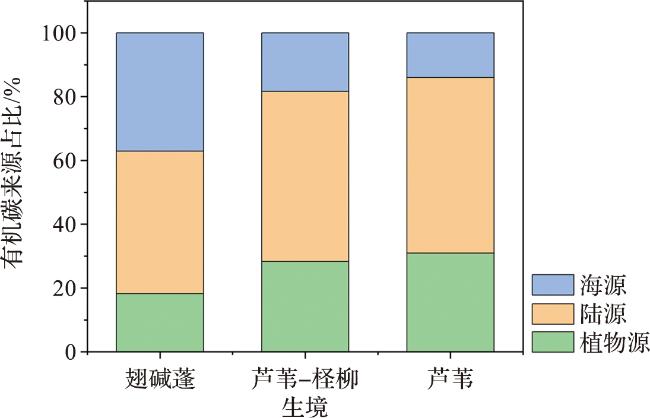
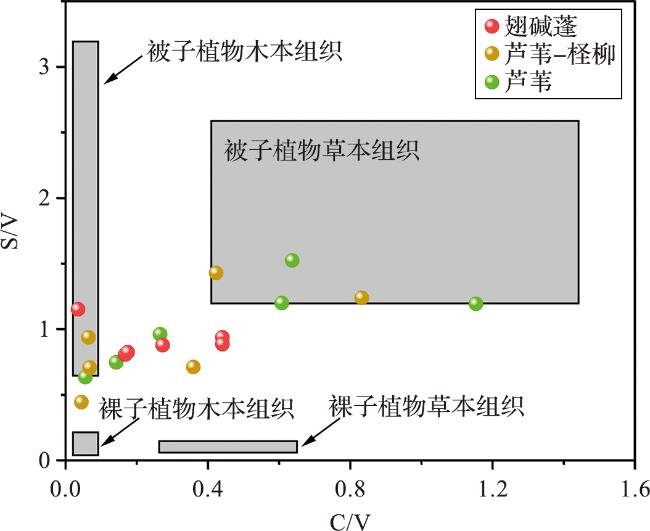
滨海湿地土壤有机碳来源可分为本地来源和异地来源。本地来源主要包括湿地本地植物和动物的残骸及其代谢产物(本文主要分析植物来源);异地来源则包括陆地来源(如地表径流和地下水输入的有机物)和海洋来源(如浮游生物和底栖生物残体)。基于蒙特卡罗模型的计算结果显示,研究区三种植被生境土壤有机碳以陆源(47.7%±13.2%)和植物源(36.3%±15.0%)为主,海源贡献较低(16.0%±14.2%)。翅碱蓬的生物量较低,且其生境最靠近海洋,因此其土壤中有机碳的植物源占比较低,而海源占比相对较高;芦苇耐盐度低,主要分布在河流沿岸,生物量在三种植物中最高,故其生境土壤中有机碳的植物源占比最高,海源占比最低(图4)。
3.4 黄河口三种植被生境土壤有机碳的降解特征
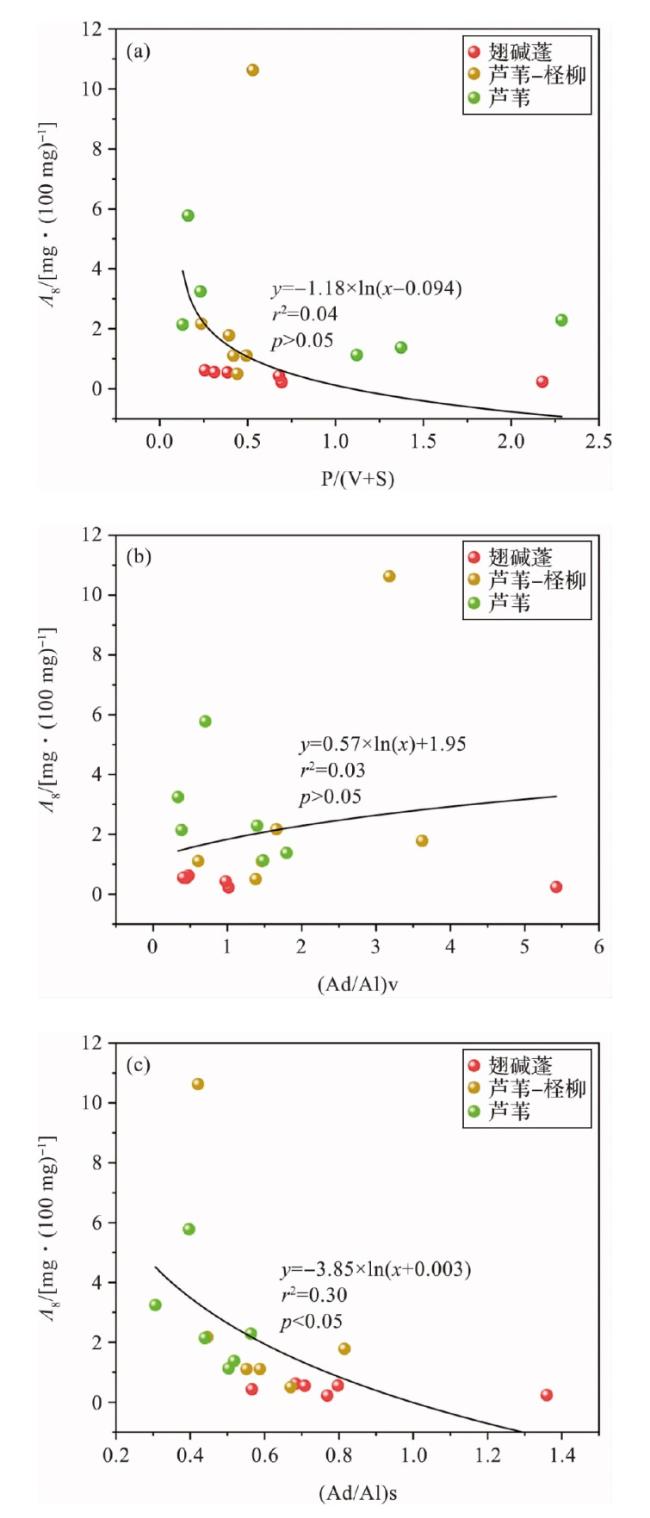
不同木质素单体的比值还可用于评估其降解程度,例如,P/(V+S)值<0.39,表示木质素降解程度较弱;P/(V+S)值在0.39~0.63之间,表示木质素降解程度为中等;P/(V+S)值>0.63,则表示木质素降解程度较强[27]。根据P/(V+S)值的分析结果可知,研究区共有7个站位的木质素降解程度较弱,5个站位为中等,另有6个站位表现出较强的降解程度。
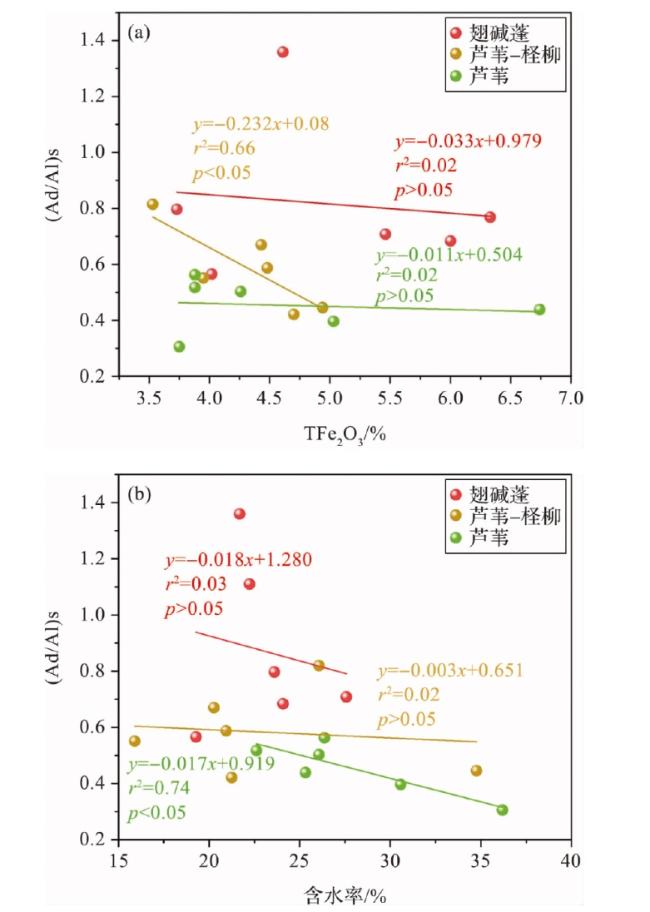
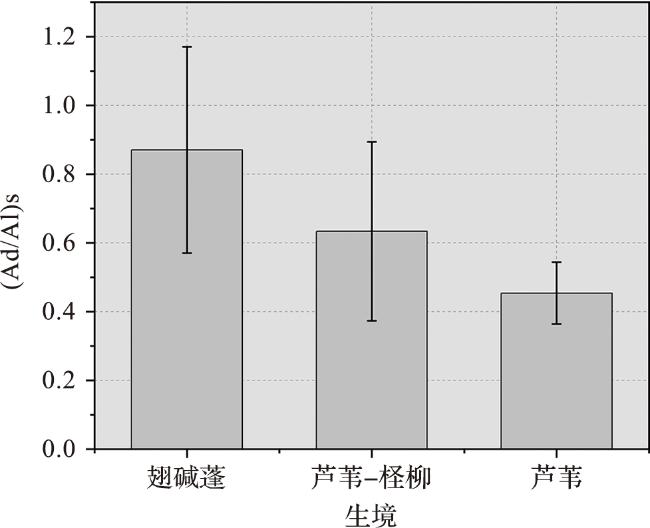
随着降解程度增加,木质素含量(Λ8)降低,木质素侧链氧化会导致S或V系列中酸类与醛类单体质量之比[以(Ad/Al)s或(Ad/Al)v表示]增加[28]。对木质素降解参数和木质素含量的关系进行对数拟合,发现相比(Ad/Al)v和P/(V+S),(Ad/Al)s与Λ8的相关性更显著(图6)。因此本文选择(Ad/Al)s作为木质素降解程度的指标。图7a显示,在芦苇-柽柳生境土壤中,(Ad/Al)s与TFe2O3呈显著负相关关系,即铁氧化物可能抑制木质素的降解,这与土壤中铁氧化物对有机质的保护作用[29]相符。由图7b可知,芦苇生境土壤中的含水率和(Ad/Al)s呈显著负相关关系。芦苇生境土壤中含水率高于其他两种植被生境土壤,过高的含水率会阻碍氧气的扩散,抑制微生物对有机质的分解[30]。翅碱蓬生境土壤有机碳中海源和陆源的异地搬运占比最高(图4),由于有机碳在长途搬运过程中会逐渐被降解,导致翅碱蓬生境土壤中的木质素降解程度高于其他生境(图8)。总的来说,黄河口湿地土壤木质素的降解受土壤性质和植被类型共同影响。


4 结论
本文对黄河口湿地三种典型植被生境土壤有机碳的分布特征、影响因素、来源及降解特征进行了研究。结果表明,研究区土壤有机碳含量为0.34%~1.85%,平均值为0.84%,低于全国平均水平,主要归因于成陆时间短、土壤熟化程度低。研究区土壤有机碳含量同时受植被生物量和土壤黏土含量的影响,且不同植被生境土壤中有机碳受黏土的影响存在差异。来源分析显示,黄河口湿地三种植被生境土壤有机碳以陆源(47.7%±13.2%)和植物源(36.3%±15.0%)为主,海源贡献较低(16.0%±14.2%),其中海源有机碳占比受地理位置影响显著。土壤木质素来源表现为被子植物木本类和草本类组织的混合或单一来源,与上覆植被类型不完全一致,说明部分有机碳来源于异地搬运。此外,土壤中的水分和铁氧化物会抑制木质素的降解,而土壤有机碳的异地搬运比例较高会导致其木质素降解程度较高。