Community composition of microalgae and its contribution to carbon stock in muddy tidal flat in Aiwan Bay

  • CHEN Hao , 1, 3 ,
  • JIANG Zhibing , 1, 2, 3, 4, * ,
  • LI Lei 5 ,
  • LIU Chenggang 1 ,
  • YU Peisong 1, 3 ,
  • ZENG Jiangning 1, 3
Expand
  • 1. Key Laboratory of Marine Ecosystem Dynamics, Second Institute of Oceanography, MNR, Hangzhou 310012, China
  • 2. Key Laboratory of Ocean Space Resource Management Technology, MNR, Marine Academy of Zhejiang Province, Hangzhou 310012, China
  • 3. Key Laboratory of Nearshore Engineering Environment and Ecological Security of Zhejiang Province, Hangzhou 310012, China
  • 4. Observation and Research Station of Marine Ecosystem in the Yangtze River Delta, MNR, Zhoushan 316021, China
  • 5. School of Geography Sciences and Environment, Shijiazhuang University, Shijiazhuang 050035, China

Received date: 2024-03-25

  Revised date: 2024-04-19

  Online published: 2025-08-05

Abstract

The carbon sink capacity of muddy tidal flat plays a significant role in coastal blue carbon ecosystems. Microalgae, as the main primary producers in these habitats, are key contributors to carbon sequestration and storage. However, the community composition and carbon stock of microalgae in China’s muddy tidal flats remain poorly understanding. Here, microalgae samples were collected from muddy tidal flat of Aiwan Bay, Wenling, Zhejiang Province in August 2021. The microalgae were identified using an inverted microscope, and their carbon stock was estimated based on cellular biovolume measurements. A total of 59 species from 4 phyla were identified, with diatom being the overwhelmingly dominant group. The most abundant genera included Coscinodiscus, Nitzschia, Gyrosigma, and Synedra. The abundance and biomass of microalgae showed pronounced spatial heterogeneity across sampling sites, likely influenced by terrestrial inputs. In addition, tidal creeks caused by strong outflow from water gates might have affected the settlement and resuspension of microalgae. Based on biomass calculations, the regional microalgal carbon stock in muddy tidal flat of Aiwan Bay was estimated at approximately 2 134 t, with approximately 60% derived from settled planktonic microalgae. This study underscores the significant impact of phytoplankton on microalgal community composition and carbon storage. These findings provide valuable insights for assessing carbon sinks in muddy tidal flats and contribute to a better understanding of blue carbon dynamics in coastal ecosystems.

Cite this article

CHEN Hao , JIANG Zhibing , LI Lei , LIU Chenggang , YU Peisong , ZENG Jiangning . Community composition of microalgae and its contribution to carbon stock in muddy tidal flat in Aiwan Bay[J]. Journal of Marine Sciences, 2025 , 43(2) : 97 -106 . DOI: 10.3969/j.issn.1001-909X.2025.02.011

0 引言

随着工业化、城市化进程加快,人类活动排放的大量CO2引发了一系列环境和社会问题。实现碳中和已成为全球共识,对社会经济可持续发展至关重要。当前,各国的碳中和措施以减排为主,但仅靠减排仍难以实现目标,还需同步推进增汇措施[1]。海岸带蓝碳生态系统具有巨大的固碳增汇潜力,仅我国就储存了约1.18×10⁸ 吨碳[2]。我国无植被潮滩面积占潮间带总面积的75%,其年碳汇量占潮间带总碳汇量的73%,是海岸带蓝碳的重要组成部分[2]。然而,现有研究主要集中于盐沼湿地、红树林等具植被滩涂的固碳机制,无植被潮滩的碳汇贡献常被忽视[3-4]。无植被潮滩的高碳汇能力主要得益于其较高的沉积物埋藏速率[2,4]。沉积物中埋藏的碳主要包括生物残体、有机碎屑及结合态有机碳组分,而微藻在其中的贡献尤为显著。
生活在水体沿岸和沉积物表面的微型藻类,为淤泥质滩涂等无植被潮滩的重要生产者,其对生态系统初级生产力的贡献极大[5],在物质循环和能量流动中发挥关键作用,并能在一定程度上改变生境特征[6]。一方面微藻能够固定CO2,合成有机物,是底栖动物的重要食物来源[7],并可通过再悬浮作用参与水-底界面的物质输送与耦合[8],对近海次级生产具有重要影响[9]。另一方面微藻除自身为碳库的组分外,其分泌的胞外聚合物还能在沉积物表面形成生物膜,进一步增加碳储量[10]。此外,这种生物膜能增强沉积物的稳定性,减少潮水侵蚀[11-12],有利于碳在沉积物中的埋藏和封存。因此,淤泥质滩涂(潮间带)微藻的群落组成及其碳储量贡献,对蓝碳生态系统具有重要意义。
目前,对我国淤泥质滩涂微藻群落组成及其对碳储量贡献的认识仍显不足。与水体中浮游藻类研究相比,我国滩涂中微藻研究起步较晚,相关报道较少,现有成果主要集中于群落分布与生产力特征[13-19]。已有研究大多基于叶绿素a质量浓度计算微藻生物碳量[20-21],这种方法难以准确评估淤泥质滩涂中微藻的碳储量。为此,亟需开展基于细胞生物体积的微藻碳储量估算研究。基于此,本研究以浙江省隘顽湾为研究区域,通过分析2021年8月潮间带微藻的丰度、生物量、群落组成及其空间分布特征,估算其生物碳库,以期为淤泥质滩涂固碳增汇能力评估提供科学依据。

1 材料与方法

1.1 调查区域与站位布设

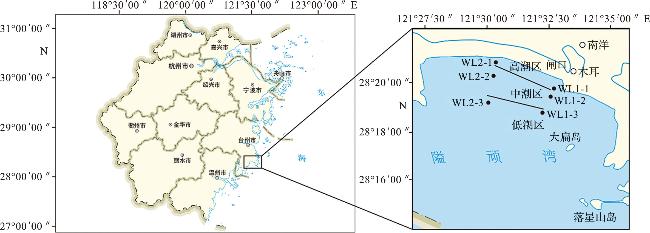
隘顽湾位于浙江省台州市温岭市,地处温黄平原南部,为半圆形海湾。其东西长约14.8 km,南北宽约14.4 km,海域面积约124 km2,水深多在5 m以内,沿岸淤泥质滩涂广阔[22],是研究淤泥质滩涂微藻碳储量的理想区域。本次调查设置2条断面,共6个点位(图1)。
图1 隘顽湾泥滩微藻采样断面与站位

Fig.1 Location of sampling sections and stations for microalgae in the mudflat of Aiwan Bay

1.2 样品采集及处理

使用2.2 cm内径的小型底栖生物采样管随机采集5 cm长芯样,按0~2 cm(定容至20 mL)、2~5 cm(定容至30 mL)分层,用2.5%甲醛于50 mL样品瓶中固定保存。取5 mL样品经超声波分散后过10 μm孔径的网筛,经少量过滤后的海水多次润洗,将收集到的微藻转移到60 mL离心管并定容至10 mL。吸取1 mL微藻浓缩液至1 mL浮游生物计数框,进行显微镜细胞鉴定与计数。微藻的形态学鉴定参考《中国海藻志》[23]和《中国海洋底栖硅藻类(上、下)》[24-25]。采样及样品处理方法均参考《海洋微型底栖生物调查规范》(HY/T 140—2011)[26]

1.3 微藻群落结构分析

考虑到不同微藻种类的细胞大小不同,相同丰度下其对碳汇的贡献可能存在显著差异,基于微藻细胞碳含量换算的生物量,计算得到的多样性指数更能反映微藻群落结构。故分别基于细胞密度计算丰度多样性指数(H'a)和均匀度指数(J'a),基于生物量计算生物量多样性指数(H'b)和均匀度指数(J'b)。文中涉及到的群落结构分析计算公式如下
$H^{\prime}=-\sum_{i=1}^{S} P_{i} \times \ln \left(P_{i}\right)$
J'= H ' l n S
式中: H'为Shannon多样性指数,Pi为第i个种的细胞密度(或生物量)占总细胞密度(或总生物量)的比值,J'为均匀度指数,S为微藻的种类数。

1.4 生物量及碳库计算

生物量计算采用生物体积换算法。将镜检记录的每种微藻的长、宽、高(随机选取3个微藻细胞个体取平均值)按其大体几何形状换算为细胞体积。细胞体积根据几何图形和相应公式进行估算[27]。使用SPSS 25.0软件对不同断面和深度的微藻丰度及生物量差异进行Kruskal-Wallis检验。
根据微藻类群差异(硅藻和其他藻类),采用不同的转换系数将生物体积转换为细胞碳含量,转换公式如下[28]
硅藻:
log10C=0.76×(log10V)-0.352
其他藻类:
log10C=0.94×(log10V)-0.60
式中:C为每个细胞的碳含量(单位:×10-6μg),V为细胞体积(单位:μm3)。
将生物体积转换为细胞碳含量后,将样品中各微藻种群的碳含量累加,得到样品中以碳计的微藻总生物量,计算公式如下
$B=\sum_{i=1}^{N} C_{i} \times D_{i}$
式中:B为样品中以碳计的微藻总生物量(单位:μg/cm3);N为样品的总藻类数(无量纲);Ci为第i个种群微藻的个体细胞碳含量(单位:μg);Di为第i个种群微藻的细胞丰度(单位:cells/cm3)。
区域内淤泥质滩涂微藻碳库储量计算公式如下
$C_{\text {stock }}=\frac{\sum_{i=1}^{N} C_{i}}{n} \times A \times 10^{-5}$
$C_{i}=\sum_{j=1}^{N} B_{j} \cdot L_{j}$
式中:Cstock为淤泥质滩涂微藻碳储量(单位:kg),A为淤泥质滩涂总面积(单位:m2),Ci为第i个样芯的有机碳含量(单位:μg/cm2),n为样地数量(无量纲),Bj为样芯第j层分样微藻碳生物量(单位:μg/cm3),Lj为第j层分样厚度(单位:cm)。

2 结果与讨论

2.1 微藻的群落构成与生态类型

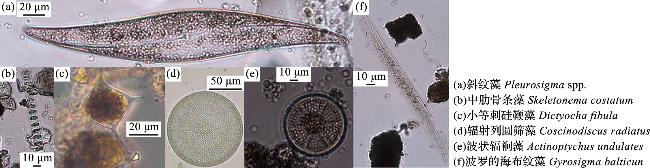
本次调查在隘顽湾共检出微藻4门59种,其中硅藻51种、甲藻4种、金藻和绿藻各2种。主要优势种如表1所示,除金藻门的小等刺硅鞭藻Dictyocha fibula外,其余优势种均为硅藻,包括辐射列圆筛藻Coscinodiscus radiatus、钝头菱形藻Nitzschia obtusa、弯菱形藻Nitzschia sigma、小眼圆筛藻Coscinodiscus oculatus等。部分优势种的显微图片见图2
表1 隘顽湾泥滩微藻主要优势种丰度与生物量

Tab.1 Abundance and biomass of the main species of microalgae in the mudflat of Aiwan Bay

优势种 丰度/(×103 cells·cm-3) 丰度占比/% 生物量/(μg·cm-3) 生物量占比/%
辐射列圆筛藻 Coscinodiscus radiatus 0.84±0.54 10.43 1.00±0.64 13.32
钝头菱形藻 Nitzschia obtusa 钝头菱形藻 Nitzschia obtusa 0.50±0.66 6.16 0.28±0.37 3.76
弯菱形藻 Nitzschia sigma 0.42±0.34 5.21 0.06±0.05 0.84
小眼圆筛藻 Coscinodiscus oculatus 0.35±0.17 4.30 0.37±0.19 4.98
长尾布纹藻 Gyrosigma macrum 0.33±0.26 4.06 0.05±0.04 0.73
长端节肋缝藻 Frustulia lewisiana 0.32±0.37 4.01 0.26±0.29 3.45
波状辐裥藻 Actinoptychus undulates 0.27±0.19 3.38 0.12±0.08 1.64
波罗的海布纹藻 Gyrosigma balticum 0.28±0.17 3.48 0.45±0.27 6.06
斜纹藻 Pleurosigma spp. 0.24±0.18 2.97 0.26±0.20 3.56
平片针杆藻 Synedra tabulata 0.24±0.33 2.93 0.03±0.04 0.39
星脐圆筛藻仿玟纹变种 Coscinodiscus asteromphalus var. subbuliens 0.21±0.11 2.54 0.56±0.30 7.47
小等刺硅鞭藻 Dictyocha fibula 0.22±0.19 2.70 0.46±0.40 6.07
流水双菱藻 Surirella fluminensis 0.20±0.12 2.47 0.15±0.10 2.07
中肋骨条藻 Skeletonema costatum 0.58±1.18 7.23 0.02±0.05 0.31
斯氏布纹藻 Gyrosigma spencerii 0.20±0.19 2.54 0.03±0.03 0.46
图2 隘顽湾泥滩部分微藻优势种显微图片

Fig.2 Microscopic images of dominant microalgae species in the mudflat of Aiwan Bay

由于不同种类细胞体积差异显著,优势种的丰度与生物量占比呈现明显差异(表1)。例如:弯菱形藻的丰度占比为5.21%,而生物量占比仅为0.84%;星脐圆筛藻仿玟纹变种Coscinodiscus asteromphalus var. subbuliens的丰度占比仅为2.54%,而生物量占比却高达7.47%。研究表明,虽然硅藻总体丰度较高,但浮游圆筛藻属等大个体浮游型种类的沉降输入致使滩涂中的底栖硅藻对区域内的生物量贡献并不明显[29]。在进行泥滩微藻研究时,往往将沉降的浮游型微藻归类为底栖微藻,却忽略了沉降的输入影响[13-19]
将研究区域内检出的微藻初步划分为浮游型和底栖型两大生态类型,其中绿藻和金藻为典型的浮游型,羽纹纲硅藻主要营底栖附着生活,而圆筛藻属的生态习性尚存争议。尽管在沉积物中圆筛藻属占比较高,如1977年对东海大陆架的综合调查中,在沉积物中检出的硅藻以圆筛藻属占据种类和数量优势[30],然而,该属多数为海洋浮游性种类[24-25]。本次调查中除去部分仅营底栖生活的特定种(如蛇目圆筛藻Coscinodiscus argus、结节圆筛藻Coscinodiscus nodulifer),将其他圆筛藻归类为浮游型更为合适。

2.2 微藻各类群的数量组成与分布

隘顽湾微藻各类群数量组成如表2所示,平均丰度为 (8.04±5.55)×103 cells/cm3,平均生物量为 (7.42±5.51)μg/cm3,其中硅藻的平均丰度和生物量均最高,其占比均超过89%。除绿藻由于细胞体积小导致低生物量外,其余类群的生物量组成与丰度组成基本对应。
表2 隘顽湾泥滩微藻各类群的平均丰度与生物量

Tab.2 Average abundances and biomass among microalgal taxonomic groups in the mudflat of Aiwan Bay

种类 平均丰度/(×103cells·cm-3) 丰度占比/% 平均生物量/(μg·cm-3) 生物量占比/%
硅藻 7.67±5.34 95.44 6.68±4.84 89.94
金藻 0.23±0.21 2.85 0.47±0.43 6.34
甲藻 0.05±0.05 0.65 0.27±0.28 3.60
绿藻 0.09±0.10 1.06 0.01±0.01 0.12
合计 8.04±5.55 100 7.42±5.51 100
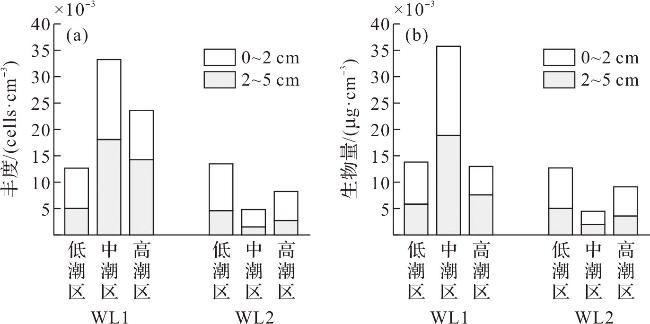
从区域内微藻丰度和生物量的组成来看,硅藻占据绝对优势。除WL1断面高潮区外,微藻丰度与生物量在平面分布和垂直分布上均表现出基本一致的分布态势(图3)。两条断面间的丰度和生物量均存在显著(p<0.05)差异,而不同深度的丰度和生物量均无显著差异。
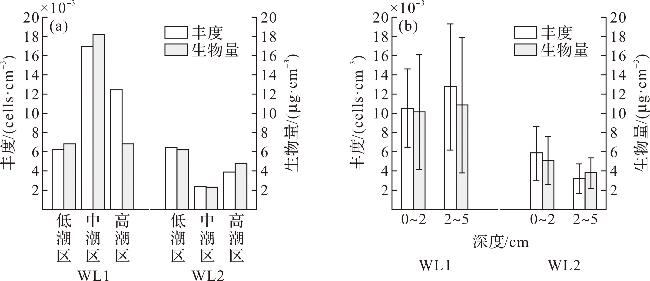
图3 隘顽湾泥滩不同潮区(a)、不同深度(b)微藻的丰度与生物量分布

Fig.3 Distribution of abundance and biomass of microalgae in different tidal zones (a)and depths (b)in the mudflat of Aiwan Bay

从平面分布看 (图3a), WL1 断面上中潮区的微藻平均丰度与生物量最高,分别为 16.94×10³ cells/cm3和18.10 μg/cm3;高潮区的平均丰度远高于低潮区,但两区的平均生物量却相近,这是因为贡献大部分丰度的骨条藻Skeletonema、直链藻Melosira和菱形藻Nitschia对生物量的贡献较小。与WL1断面不同,微藻在WL2 断面的低潮区出现最高的平均丰度与生物量,分别为 6.40×10³ cells/cm3和6.17 μg/cm3,而在WL2断面上中潮区的平均丰度与生物量最低,分别为2.36 cells/cm3和2.29 μg/cm3
从垂直分布看(图 3b),两条断面各深度的平均丰度和生物量基本表现出较好的一致性。微藻在WL1断面高潮区和中潮区2~5 cm深度的平均丰度和生物量略微高于0~2 cm,而WL2断面0~2 cm的平均丰度和生物量明显高于2~5 cm(图4)。
图4 隘顽湾泥滩不同潮区微藻丰度(a)与生物量(b)的垂直分布

Fig.4 Vertical distribution of abundance (a)and biomass (b)of microalgae in different tidal zones in the mudflat of Aiwan Bay

潮滩上不同潮区的微藻丰度和生物量除受潮水影响外,还受到陆源输入的影响。在受潮水控制显著的低潮区,两条断面的微藻丰度和生物量相近。而在高潮区和中潮区,WL1断面的微藻丰度和生物量均高于WL2断面,这与WL1断面更靠近闸口有关。隘顽湾岸边分布大量农田,其闸口排放水的陆源营养盐浓度可能较高。一方面闸口作为陆源输入的主要排放口,其富含营养盐的淡水渗流具有明显的局部效应,可增加微藻的丰度和生物量,提高底栖生物群落的总代谢和潮间带的初级生产力[31];另一方面,开闸放水时的大流量输入容易切割潮滩形成潮沟[32],改变了附近的水动力系统,而细胞粒级较大的硅藻伴随泥沙在靠近潮沟的位置容易沉降[33]。而且,在WL1断面还检出了淡水浮游绿藻四尾栅藻Scenedesmus quadricauda,表明其相对WL2断面受陆源影响更强烈。

2.3 多样性指数和均匀度指数

表3所示为基于丰度和生物量计算的隘顽湾不同潮区的多样性指数(H'aH'b)和均匀度指数(J'aJ'b)。从水平分布上看,基于丰度计算的H'aJ'a均在WL1断面的中潮区出现最高值,在WL2断面的中潮区出现较低值(其中H'a为最低值),而两条断面高、低潮区的H'aJ'a数值接近。基于生物量计算的指数相较于基于丰度计算的指数,除在WL1断面的高潮区略微上升外,在其余各区域均下降。使得H'bJ'b的峰值转移至WL1断面的高潮区,谷值仍位于WL2断面的中潮区。有别于基于丰度的计算结果,在使用生物量计算多样性指数和均匀度指数时,WL1断面的结果整体上略高于WL2断面。
表3 隘顽湾泥滩不同潮区微藻的多样性指数和均匀度指数

Tab.3 Diversity and evenness indices of microalgae in different tidal zones in the mudflat of Aiwan Bay

指数 WL1断面 WL2断面
高潮区 中潮区 低潮区 高潮区 中潮区 低潮区
H'a 3.24 3.46 3.23 3.32 2.95 3.14
H'b 3.32 3.20 2.94 3.00 2.59 2.84
J'a 0.84 0.89 0.86 0.87 0.84 0.83
J'b 0.86 0.82 0.78 0.79 0.74 0.76
表4所示为基于丰度和生物量计算的隘顽湾不同深度的多样性指数(H'aH'b)和均匀度指数(J'aJ'b)。从垂直分布上看,相较基于丰度计算的多样性指数和均匀度指数,基于生物量计算的结果均出现明显下降。无论采用何种计算方法,WL1断面两个深度和WL2断面0~2 cm深度的均匀度指数相近,多样性指数在WL1断面略高,以WL1断面2~5 cm深度的多样性指数相对最高。H'aJ'aH'bJ'b的最低值均出现在WL2断面的2~5 cm深度。
表4 隘顽湾泥滩不同深度微藻的多样性指数和均匀度指数

Tab.4 Diversity and evenness indices of microalgae at different depths in the mudflat of Aiwan Bay

指数 WL1断面 WL2断面
0~2 cm 2~5 cm 0~2 cm 2~5 cm
H'a 3.47 3.51 3.41 3.10
H'b 3.18 3.29 3.07 2.74
J'a 0.87 0.87 0.89 0.82
J'b 0.80 0.81 0.80 0.72

2.4 微藻碳储量及来源

基于硅藻和其他类群的生物量估算,隘顽湾单位面积微藻碳储量平均为37.1 g/m2,按滩涂面积57.51 km2计算,隘顽湾微藻总碳储量为2 134 t。同步调查显示,隘顽湾沉积物有机碳总量为2.6×10⁵ t(未发表数据),微藻贡献占比约为0.82%。如图5所示,微藻碳储量的空间分布呈显著异质性:WL1 断面高潮区、中潮区和低潮区微藻单位面积碳储量分别为 32.8、89.5和34.8 g/m2,WL2断面高潮区、中潮区和低潮区微藻单位面积碳储量分别为31.9、11.6和23.1 g/m2,两个断面低潮区与高潮区的碳储量水平接近,而WL1断面的中潮区碳储量明显偏高。
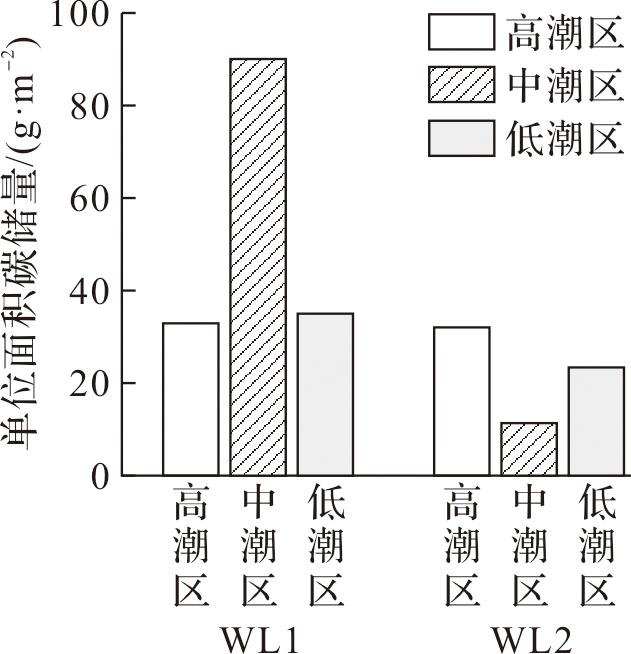
图5 隘顽湾泥滩微藻碳储量的水平分布

Fig.5 Horizontal distribution of carbon stock of microalgae in the mudflat of Aiwan Bay

将微藻来源分为浮游型和底栖型两类后,对其生物量构成进行分析,将微藻细胞生物体积转换成生物量进行表示,结果如图6所示。
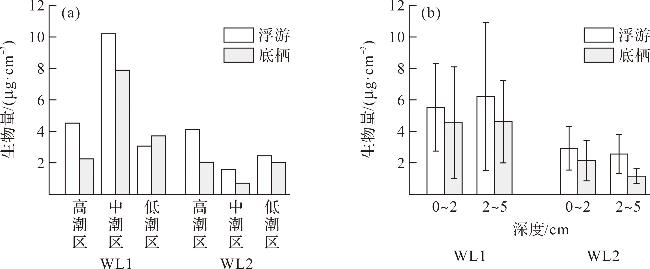
图6 浮游和底栖微藻对隘顽湾泥滩不同潮区(a)和深度(b)微藻生物量的贡献

Fig.6 Contribution of planktonic and benthic microalgae to microalgae biomass in different tidal zones (a)and depths (b)in the mudflat of Aiwan Bay

整体而言,微藻来源以浮游型为主,平均约占总生物量的60%,但该比例存在潮区分异(图6)。相较于受到频繁潮汐扰动和高光胁迫引发光抑制的高潮区[34-35],中潮区和低潮区底栖微藻固着生长优势明显,其丰度和生物量较高,从而降低了浮游型微藻的相对占比[36]。而且本次采样恰逢大潮期,强劲的潮汐作用输送了大量浮游植物进入高潮区,提高了该区域浮游型微藻的占比[37]。从垂直分布来看,2~5 cm深度的浮游型种类往往意味着历史性沉积,另外,由于羽纹纲硅藻(多属于底栖硅藻)具有一定的垂直迁移能力[38-39],使得2~5 cm的浮游型微藻的占比较0~2 cm高。
虽然本次调查结果表明泥滩沉积物中的微藻碳储量相对沉积物碳储量较低,但其生态功能在滩涂碳通量和碳埋藏过程中起着重要作用。微藻的初级生产是泥滩生态系统中最主要的固碳过程,除去以个体形式沉积以及向下一营养级转移外,其分泌的胞外聚合物也是沉积物有机碳的重要组成部分,这一部分甚至可达光照期间固定碳的40%~73%[40]。另外,本研究在估算微藻碳储量时仅计算了较完整的个体,没有考虑破碎部分和样品前处理中被滤掉的小型个体(<10 μm),可能低估了微藻碳储量。

3 结论

微藻碳库是淤泥质滩涂碳储量的重要组成部分,也是连通各生物碳库的重要纽带。本次调查结果显示,隘顽湾泥滩潮间带微藻种类丰富,多样性较高,其中硅藻在丰度和生物量上均占据绝对优势。受陆源输入影响,两条断面在生物量和丰度方面表现出明显的空间异质性,但其浮游型微藻的沉降输入占比相似。根据微藻生物量估算,调查期间隘顽湾微藻碳储量为2 134 t,约占隘顽湾总碳储量的0.82%。值得注意的是,微藻碳储量中浮游型微藻的沉降输入占比约为60%,表明外源碳输入很可能在淤泥质滩涂的碳储量中占据重要地位。需要说明的是,受调查方案限制,单季度数据不能准确代表隘顽湾的全年情况,且站位设置不够充足,两条断面差异较大,可能对其碳储量估算产生影响,但本次调查结果仍可为微藻碳储量的研究提供参考。
[1]
焦念志. 研发海洋“负排放” 技术支撑国家“碳中和” 需求[J]. 中国科学院院刊, 2021, 36(2):179-187.

JIAO N Z. Developing ocean negative carbon emission tech-nology to support national carbon neutralization[J]. Bulletin of Chinese Academy of Sciences, 2021, 36(2): 179-187.

[2]
WANG F M, LIU J H, QIN G M, et al. Coastal blue carbon in China as a nature-based solution toward carbon neutrality[J]. The Innovation, 2023, 4(5): 100481.

[3]
NELLEMANN C, CORCORAN E, DUARTE C M, et al. Blue carbon: the role of healthy oceans in binding carbon[M]. Norway: Birkeland Trykkeri AS, 2009.

[4]
CHEN J, WANG D Q, LI Y J, et al. The carbon stock and sequestration rate in tidal flats from coastal China[J]. Global Biogeochemical Cycles, 2020, 34(11): e2020GB006772.

[5]
UNDERWOOD G J C, PERKINS R G, CONSALVEY M C, et al. Patterns in microphytobenthic primary productivity: Species-specific variation inmigratory rhythms and photosyn-thetic efficiency in mixed-species biofilms[J]. Limnology and Oceanography, 2005, 50(3): 755-767.

[6]
MILLER D C, GEIDER R J, MACINTYRE H L. Micro-phytobenthos: The ecological role of the “secret garden” of unvegetated, shallow-water marine habitats. II. role in sedi-ment stability and shallow-water food webs[J]. Estuaries, 1996, 19(2): 202-212.

[7]
HERMAN P, MIDDELBURG J J, WIDDOWS J, et al. Stable isotopes as trophic tracers: Combining field sampling and manipulative labelling of food resources for macrobenthos[J]. Marine Ecology Progress Series, 2000, 204: 79-92.

[8]
TYLER A C, MCGLATHERY K J, ANDERSON I C. Benthic algae control sediment: Water column fluxes of organic and inorganic nitrogen compounds in a temperate lagoon[J]. Limnology and Oceanography, 2003, 48(6): 2125-2137.

[9]
YOSHINO K, TSUGEKI N K, AMANO Y, et al. Intertidal bare mudflats subsidize subtidal production through outwelling of benthic microalgae[J]. Estuarine, Coastal and Shelf Science, 2012, 109: 138-143.

[10]
BOHÓRQUEZ J, MCGENITY T J, PAPASPYROU S, et al. Different types of diatom-derived extracellular polymeric substances drive changes in heterotrophic bacterial commu-nities from intertidal sediments[J]. Frontiers in Microbiology, 2017, 8: 245.

[11]
STAL L J. Microphytobenthos as a biogeomorphological force in intertidal sediment stabilization[J]. Ecological Engineering, 2010, 36(2): 236-245.

[12]
UBERTINI M, LEFEBVRE S, RAKOTOMALALA C, et al. Impact of sediment grain-size and biofilm age on epipelic microphytobenthos resuspension[J]. Journal of Experimental Marine Biology and Ecology, 2015, 467: 52-64.

[13]
陈兴群, 陈其焕, 张明. 厦门潮间滩涂小型底栖硅藻和叶绿素的分布[J]. 生态学报, 1991, 11(4):372-376.

CHEN X Q, CHEN Q H, ZHANG M. Distribution of chlorophyll and benthic diatoms in the intertidal flat around Xiamen[J]. Acta Ecologica Sinica, 1991, 11(4): 372-376.

[14]
姜祖辉, 陈瑞盛, 王俊. 胶州湾红岛潮间带底栖微藻种类组成及其生物量变化[J]. 海洋水产研究, 2007, 28(5):74-81.

JIANG Z H, CHEN R S, WANG J. Species composition and biomass of microphytobenthos in intertidal zone of Hongdao Island, Jiaozhou Bay[J]. Marine Fisheries Research, 2007, 28(5): 74-81.

[15]
闵华明, 马家海. 上海市滩涂夏季底栖硅藻初步研究[J]. 热带亚热带植物学报, 2007, 15(5):390-398.

MIN H M, MA J H. Benthic diatoms from the tidal flat of Shanghai, China, during 2005 summer[J]. Journal of Tropical and Subtropical Botany, 2007, 15(5): 390-398.

[16]
商栩, 管卫兵, 张经. 长江口盐沼湿地底栖微藻的分布特征及其对有机质产出的贡献[J]. 海洋学报, 2009, 31(5):40-47.

SHANG X, GUAN W B, ZHANG J. Distribution charac-teristics and contribution to total primary production of microphotobenthos in the salt marshes of the Changjiang Estuary[J]. Acta Oceanologica Sinica, 2009, 31(5): 40-47.

[17]
吴瑞, 蓝东兆, 高亚辉, 等. 象山港潮间带底栖硅藻的分布及其与环境关系探讨[J]. 台湾海峡, 2008, 27(4):445-451.

WU R, LAN D Z, GAO Y H, et al. Preliminary study on the distribution of benthic diatoms and their environments in intertidal zone of Xiangshan Bay[J]. Journal of Oceano-graphy in Taiwan Strait, 2008, 27(4): 445-451.

[18]
徐帅帅, 邸宝平, 王玉珏, 等. 我国典型潮间带底栖硅藻群落空间分布特征[J]. 海洋学报, 2017, 39(6):95-113.

XU S S, DI B P, WANG Y J, et al. Spatial distribution of benthic diatom in the typical intertidal zones in China[J]. Haiyang Xuebao, 2017, 39(6): 95-113.

[19]
尹晖, 孙耀, 石晓勇, 等. 乳山湾东流区滩涂底栖微藻现存量和初级生产力[J]. 海洋水产研究, 2006, 27(3):62-66.

YIN H, SUN Y, SHI X Y, et al. Biomass and primary productivity of the microphytobenthos on mudflats of the Rushan Bay east flow area[J]. Marine Fisheries Research, 2006, 27(3): 62-66.

[20]
国家质量监督检验检疫总局, 中国国家标准化管理委员会. 海洋调查规范第6部分:海洋生物调查: GB/T 12763.6—2007[S]. 北京: 中国标准出版社, 2008.

General Administration of Quality Supervision, Inspection and Quarantine of the People’s Republic of China, Standardization Administration of the People’s Republic of China. Specifications for oceanographic survey—Part 6: Marine biological survey: GB/T 12763.6—2007[S]. Beijing: Standards Press of China, 2008.

[21]
李少朋, 邢前国. 潮滩底栖微藻生物量垂直变化对其遥感反演模式的影响[J]. 生态科学, 2014, 33(6):1155-1159.

LI S P, XING Q G. Impacts of vertical distribution of microphytobenthos biomass in surface tidal flat sediments on its remote sensing retrieval algorithms[J]. Ecological Science, 2014, 33(6): 1155-1159.

[22]
台州史志网. 台州地区志[EB/OL]. (2019-01-04)[2024-03-29]. http://tzsz.zjtz.gov.cn/art/2019/1/14/art_1229206642_54283679.html.

Taizhou Historical Record Website. Taizhou local chronicles[EB/OL]. (2019-01-04)[2024-03-29]. http://tzsz.zjtz.gov.cn/art/2019/1/14/art_1229206642_54283679.html.

[23]
中科院中国孢子植物志编辑委员会. 中国海藻志[M]. 北京: 科学出版社, 2019.

Editorial Committee of Flora Cryptogamica Sinica, Chinese Academy of Sciences. Marine algal flora of China[M]. Beijing: China Science Publishing, 2019.

[24]
金德祥, 程兆第, 林均民, 等. 中国海洋底栖硅藻类:上卷[M]. 北京: 海洋出版社, 1982.

JIN D X, CHENG Z D, LIN J M, et al. Marine benthic diatoms in China: volume I[M]. Beijing: Ocean Press, 1982.

[25]
金德祥, 程兆第, 刘师成, 等. 中国海洋底栖硅藻类:下卷[M]. 北京: 海洋出版社, 1992.

JIN D X, CHENG Z D, LIU S C, et al.. Marine benthic diatoms in China: volume II[M]. Beijing: Ocean Press, 1992.

[26]
中华人民共和国国家海洋局. 海洋微型底栖生物调查规范: HY/T 140—2011[S]. 北京: 中国标准出版社, 2011.

State Oceanic Administration of the People’s Republic of China. Specifications for the survey of marine microbenthos: HY/T 140—2011[S]. Beijing: Standards Press of China, 2011.

[27]
SUN J, LIU D Y. Geometric models for calculating cell biovolume and surface area for phytoplankton[J]. Journal of Plankton Research, 2003, 25(11): 1331-1346.

[28]
EPPLEY R W, REID F M H, STRICKLAND J D H. Estimates of phytoplankton crop size, growth rate, and primary production[M]//STRICKLAND J D. The ecology of the plankton off La Jolla, California in the period April through September. California: Scripps Institution of Oceano-graphy, 1970: 33-42.

[29]
LUCAS C H, BANHAM C, HOLLIGAN P M. Benthic-pelagic exchange of microalgae at a tidal flat. 2. Taxonomic analysis[J]. Marine Ecology Progress Series, 2001, 212: 39-52.

[30]
金德祥, 程兆第, 林均民, 等. 东海表层沉积硅藻[J]. 海洋学报, 1980, 2(1):97-110.

JIN D X, CHENG Z D, LIN J M, et al. Diatoms from the surface sediments of the East China Sea[J]. Acta Oceanologica Sinica, 1980, 2(1): 97-110.

[31]
MIGNÉ A, OUISSE V, HUBAS C, et al. Freshwater seepages and ephemeral macroalgae proliferation in an intertidal bay: II. Effect on benthic biomass and metabolism[J]. Estuarine, Coastal and Shelf Science, 2011, 92(1): 161-168.

[32]
邵虚生. 潮沟成因类型及其影响因素的探讨[J]. 地理学报, 1988, 43(1):35-43.

DOI

SHAO X S. Genetic classification of tidal creek and factors affecting its development[J]. Acta Geographica Sinica, 1988, 43(1): 35-43.

DOI

[33]
李鹏, 杨世伦, 秦渭华. 基于潮沟定点观测的潮间带水、沙、盐交换研究:以长江口九段沙一潮沟为例[J]. 海洋与湖沼, 2014, 45(1):126-133.

LI P, YANG S L, QIN W H. Interchange of water-sediment-salinity over an intertidal flat in Jiuduan shoal in the Changjiang River estuary[J]. Oceanologia et Limnologia Sinica, 2014, 45(1): 126-133.

[34]
FRANKENBACH S, EZEQUIEL J, PLECHA S, et al. Synoptic spatio-temporal variability of the photosynthetic productivity of microphytobenthos and phytoplankton in a tidal estuary[J]. Frontiers in Marine Science, 2020, 7: 170.

[35]
HARO S, BOHÓRQUEZ J, LARA M, et al. Diel patterns of microphytobenthic primary production in intertidal sediments: the role of photoperiod on the vertical migration circadian rhythm[J]. Scientific Reports, 2019, 9(1): 13376.

DOI PMID

[36]
TSUJI Y, MONTANI S. Spatial variability in an estuarine phytoplankton and suspended microphytobenthos community[J]. Plankton and Benthos Research, 2017, 12(3): 190-200.

[37]
REDZUAN N S, UNDERWOOD G J. Movement of micro-phytobenthos and sediment between mudflats and salt marsh during spring tides[J]. Frontiers in Marine Science, 2020, 7: 496.

[38]
COELHO H, VIEIRA S, SERÔDIO J. Endogenous versus environmental control of vertical migration by intertidal benthic microalgae[J]. European Journal of Phycology, 2011, 46(3): 271-281.

[39]
KINGSTON M B. Wave effects on the vertical migration of two benthic microalgae: Hantzschia virgata var. intermedia and Euglena proxima[J]. Estuaries, 1999, 22(1): 81-91.

[40]
DE BROUWER J F C, STAL L J. Short-term dynamics in microphytobenthos distribution and associated extracellular carbohydrates in surface sediments of an intertidal mudflat[J]. Marine Ecology Progress Series, 2001, 218: 33-44.

Outlines

/